
6 Benefits of Mobile Commerce You Can’t Ignore in 2026
For many brands, their mobile customer experiences simply aren’t keeping up.
February 2, 2026
9 min read
In this article

Subscribe to Our Newsletter
Get mobile commerce insights. No fluff, just what you need to build smarter.

In 2026, it feels like we’re always on.
Recent data show Americans check their phones 186 times a day, with 72% using them at work and over 84% checking within 10 minutes of waking. This is having a noticeable impact on web usage worldwide: 65% of global online traffic now comes from mobile devices.
This shift has fundamentally changed humans’ shopping behavior. Customers are shopping while commuting, scrolling social media, standing in line, or walking past a storefront and thinking, “Oh yeah, I meant to check that out.”
If you can bring your phone there, you can shop there.
As mobile becomes the dominant platform, brands that prioritize it are gaining meaningful advantages across:
- Conversion
- Engagement
- Customer lifetime value
Want to be one of those brands reaping the benefits of mobile commerce (also known as mcommerce)? We’re here to help.
What is mobile commerce?
Before we explore the benefits of mobile commerce, it’s important to define it: any transaction conducted on a mobile device (such as a smartphone or tablet).
It can take place through:
- Native mobile apps
- Mobile-optimized websites
- Digital wallets/mobile payments (Shop Pay, Apple Pay, Google Pay)
- Social commerce platforms (Instagram, TikTok, Pinterest)
- QR code and NFC-triggered experiences
- Conversational interfaces (AI chatbots, conversational commerce)
76% of adults have made purchases on their mobile phones, and mobile phone sales are forecast to reach approximately $856 billion in 2027.
But despite mobile’s ubiquity, its conversion rates aren’t scaling at the same pace: 2025 ecommerce conversion rates benchmarked at 4.8% on desktop vs. 2.9% on mobile.
So, why the divide? For many brands, it’s because their mobile customer experiences simply aren’t keeping up.
Mcommerce requires a dedicated marketing strategy that accounts for the different behaviour synonymous with the platform, like shorter sessions, higher intent, and a lower tolerance for friction.
It also works best when brands design their mobile experience around the channel’s advantages instead of just rebuilding their desktop site in portrait mode. You have to understand and hone in on the benefits of the platform and tailor your experience toward them.
6 benefits of mobile commerce you can’t ignore
Below, we’ve highlighted six key advantages of mcommerce and how you can implement them as part of your app conversion optimization strategy.
1. Convenience makes the path to purchase easier
Everyone’s on their phones. A lot.
That level of convenience is impossible to beat when compared to other sales channels. Theoretically, people always have the ability to make a purchase, whether it’s during their commute, on a coffee break, or while lying in bed.
With Americans spending 4.5 hours on their phones each day, mobile has become the most natural channel for impulse purchases, repeat purchases, and subscription renewals.
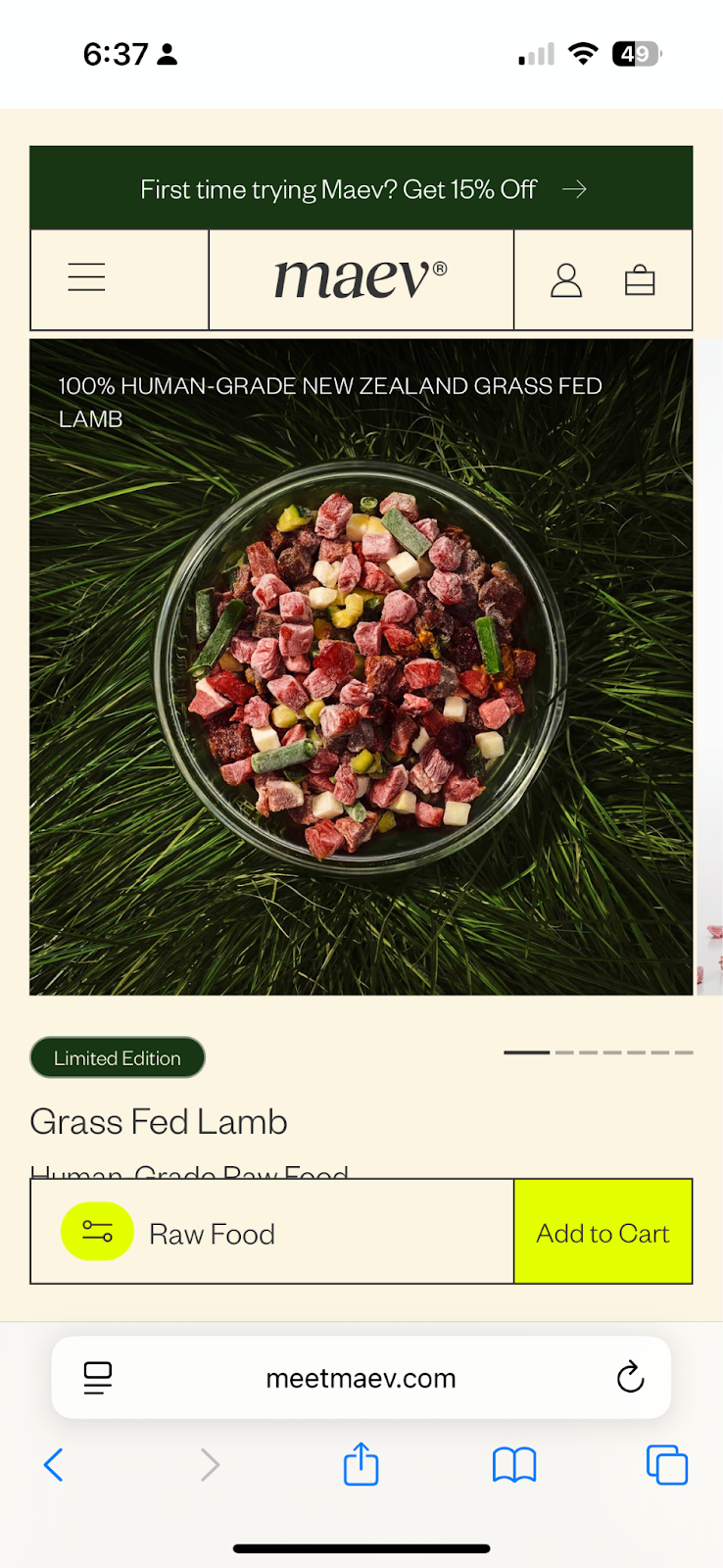
Maev, a premium dog food brand, has built an mcommerce strategy that’s as exciting for us as their food is for dogs. They’ve optimized every part of their mobile shopping experience for convenience:
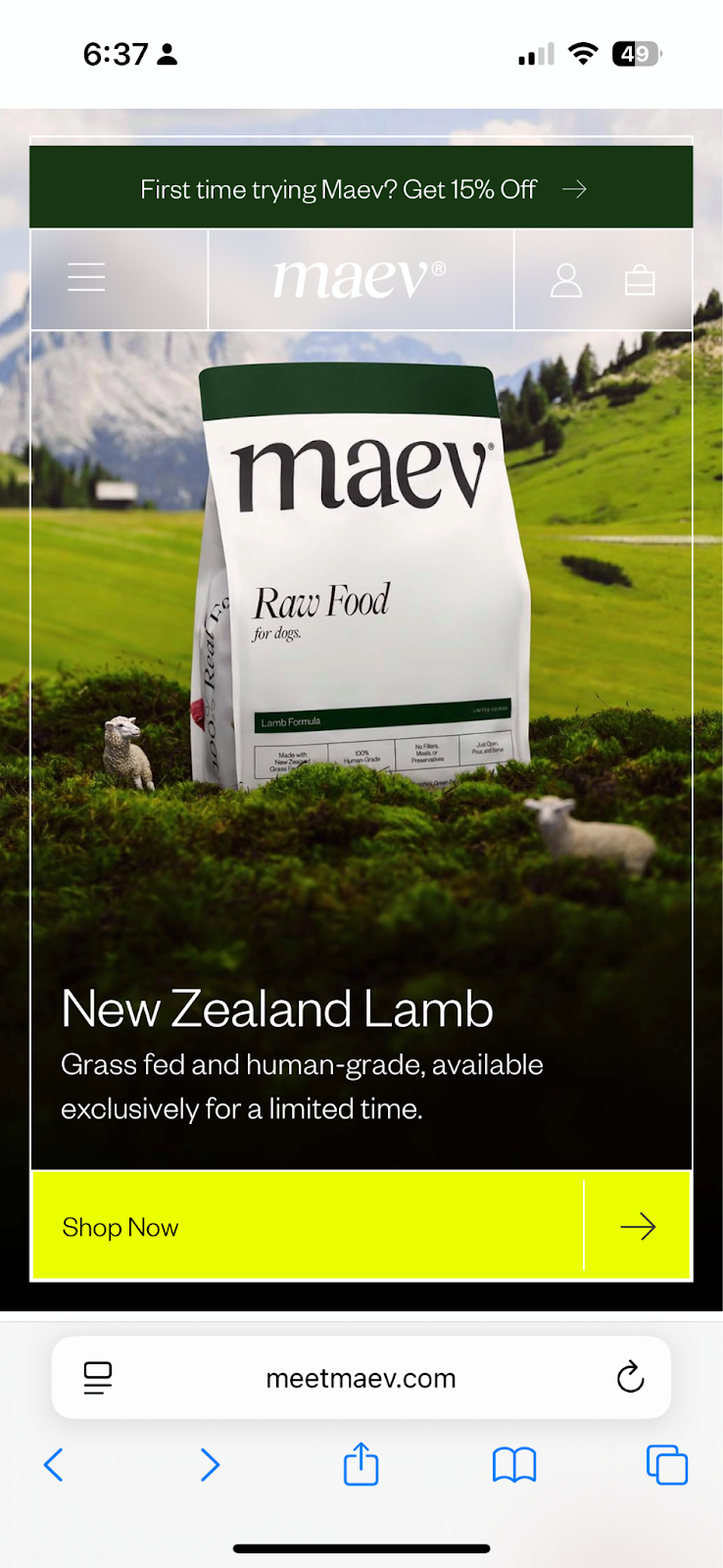
As soon as shoppers land on the site, they’re shown a best-selling product with a perfectly placed CTA to shop now. After clicking, they’re taken to the product page, where another well-placed CTA prompts them to add to cart.
For pet owners all-too familiar with the sudden “I think we're almost out of food!” panic, Maev makes it impossibly easy for its customer base to restock.
2. Faster checkout boosts mobile conversion rates
Check your phone right now (or, if you’re reading this on your phone, pull down your notification bar). You probably have at least one notification.
No, we’re not secretly tracking your phone. It’s just an educated guess, considering the average smartphone user in the US gets 46 app push notifications per day.
With that much noise competing for attention, you only have a small window of time to convert before shoppers get distracted and move on. You actually only have 3 seconds – 53% of mobile site visitors will bounce if a page takes more than 3 seconds to load.
People move fast on mobile, and your site needs to keep up. That’s why optimizing for speed is one of the best ways to drive sales on mobile.
Reducing friction wherever possible is essential, especially by:
- Offering one-tap checkout options: like Shop Pay, PayPal, Apple Pay, and Google Pay
- Saving customer information, such as addresses and payment details, to speed up repeat purchases
- Reducing the steps between product discovery and checkout, to speed up the checkout process and minimize opportunities to bounce
Integrating digital wallets into your site addresses all of these, and it’s becoming the norm. 4.5 billion people used digital/mobile wallets to pay in 2025, and Shopify data shows that Shop Pay can increase conversions by over 50% compared with guest checkout.
By pairing these strategies with push notifications, mobile apps, and SMS nudges, purchasing can become as easy as tapping a button.
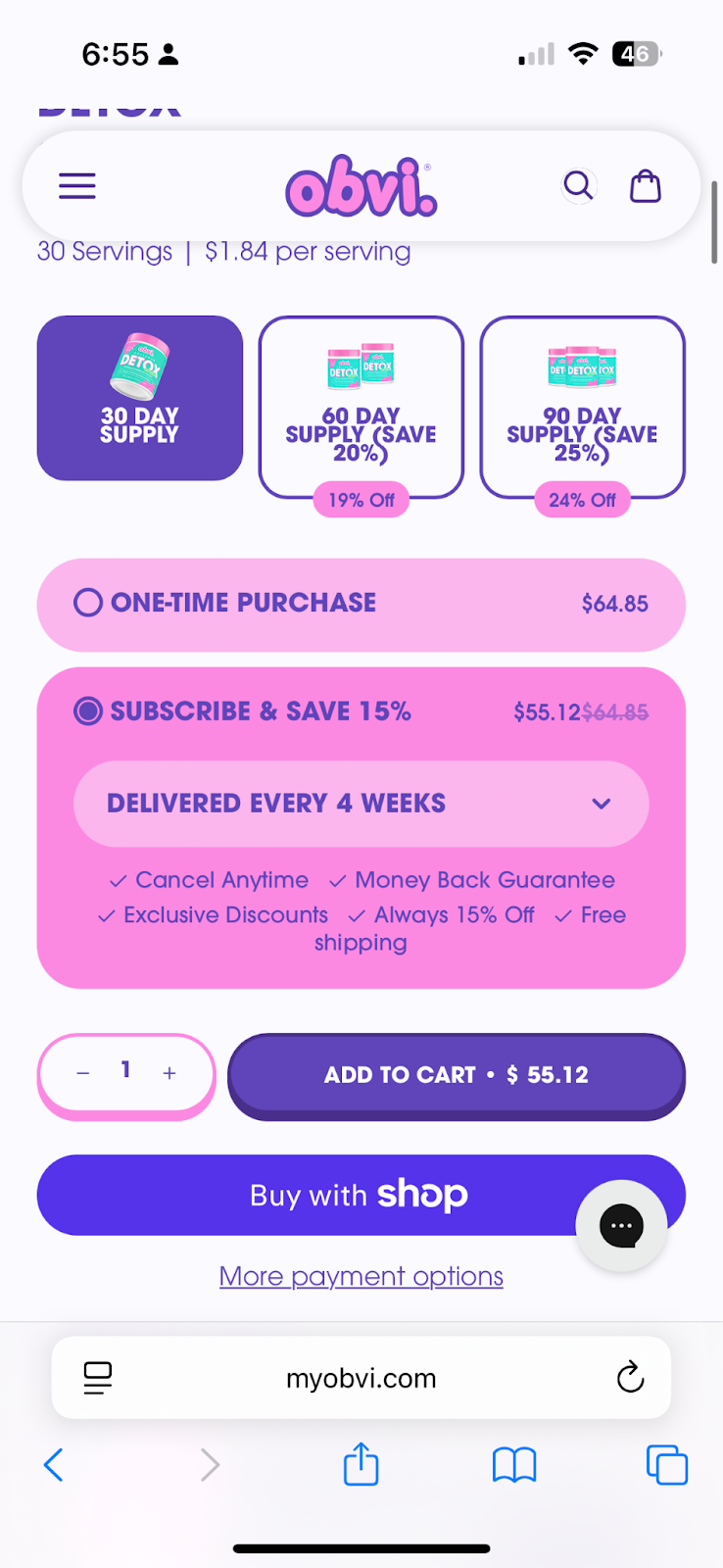
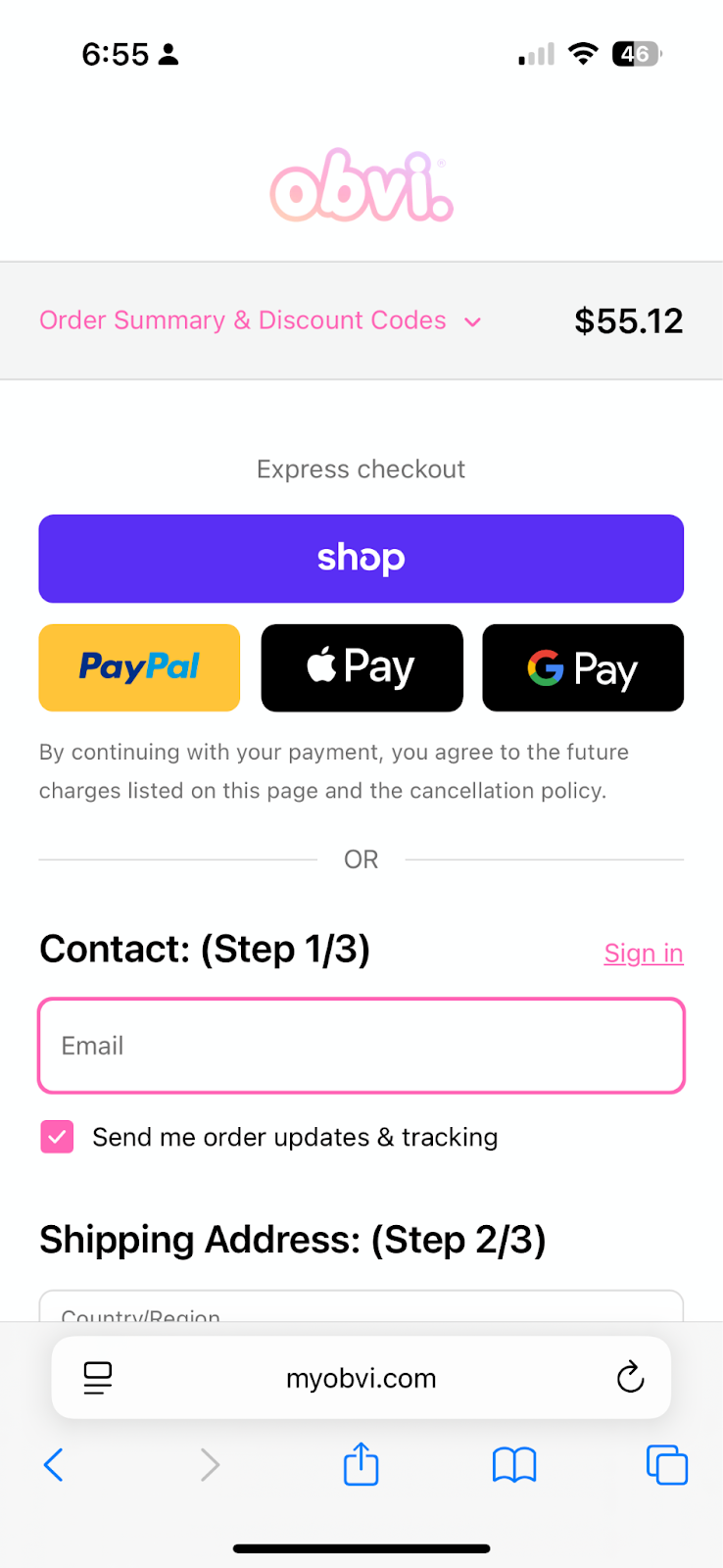
Obvi obviously knows what they’re doing when it comes to providing a lightning-fast mobile checkout experience. Customers can purchase a one-time order or subscription and pay directly on the product page – no checkout required.
For those who do enter checkout, Obvi still keeps things speedy with multiple one-tap payment options and a simple three-step checkout flow.
When it comes to discovery to purchase speed, you obvi can’t get much faster than this.
3. Mobile commerce powers social commerce purchases
The lines between social commerce and mcommerce are blurred.
64% of the global population uses social media, and 99% of social media users are accessing their platform(s) of choice on a smartphone – most people aren’t browsing TikTok from their desktop. Because of this, platforms like Instagram, Pinterest, and TikTok are built for mobile-first consumption.
While these apps are nothing new, the way people are using them is changing, with an increasing focus on commerce. 52% of American consumers have made at least one purchase on a social media platform, and 34% of 18-34 year olds are making weekly purchases.
It’s safe to say social platforms are mcommerce platforms.
These numbers aren’t surprising, because social commerce makes buying almost as easy as scrolling, by:
- Reducing friction between discovery and checkout
- Supporting impulse purchases from creator-led content
- Allowing users to buy without switching devices – or even apps
4. Personalized push notification retargeting through Reactiv Clips
Sometimes customers just need a little push… from a push notification, of course.
Push notifications allow brands to re-engage shoppers instantly while purchase intent is still high. With an open rate of 50% versus email’s 20%, push notifications are a strong way to directly reach potential customers and get their attention.
In the past, a major disadvantage of push notifications was that shoppers needed to have your app installed. But with Reactiv Clips, that barrier disappears.
Brands can send timely push notifications to customers who clicked on their ads – no install or opt-in required. The benefits of this speak for themselves. The average Reactiv Clips user sees:
- 60% open rates on personalized pushes
- 5-7% conversion rates
- Up to 400% more engagement compared to untargeted marketing campaigns
Push notifications can also be tailored even further through geolocation triggers, NFC taps, and QR codes. For example:
- A shopper walking past your store can receive a Siri prompt to explore your popular products
- Fans at a stadium can buy a jersey instantly from their phone without having to download any apps
- A nearby coffee lover can receive a notification to skip the line and order ahead from your café
Push notifications offer a powerful, mobile-native way to recover abandoned carts, send product reminders, and promote limited-time mobile commerce offers.
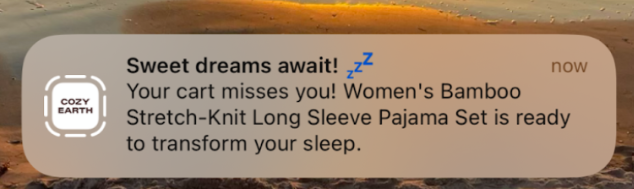
Cozy Earth knows a thing or two about it. Using tailored push notifications, they retarget shoppers who browsed a product but didn’t add it to their cart. When clicked, the notification opens an app-like experience in Reactiv Clips, then returns them to the product page to complete the purchase.
Instead of sending an abandoned cart email into the ether, Cozy Earth can re-market to customers in a more noticeable, engaging fashion wherever they are (maybe even in bed…).
5. Mobile apps are more than a shopping channel
A common misconception about mobile commerce is that apps are nothing more than mobile storefronts. But they can be so much more.
To get the most out of mcommerce, you need to optimize for more than just conversions – you need to optimize for connection.
Over 76% of customers say they’d choose to buy from a brand they feel connected to over a competitor, and 57% say they’ll spend more with a brand when they feel connected to it. Your app is the perfect vessel for this connection.
Apps allow brands to create fully-owned digital environments where they can:
- Build communities for customers to engage and interact with each other
- Offer app-exclusive products or early access opportunities
- Run quizzes, surveys, or product feedback initiatives
- Deliver educational or tutorial content
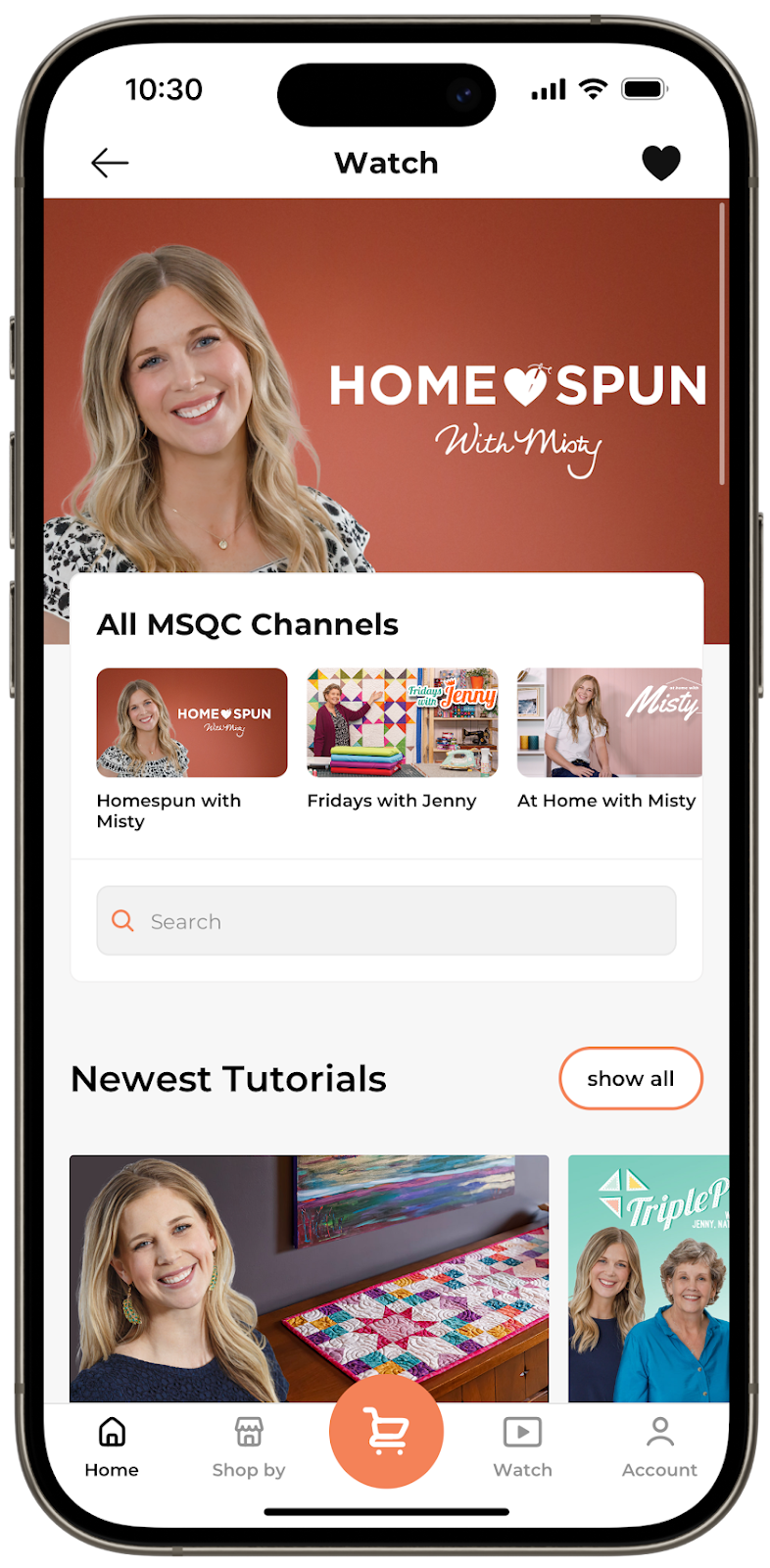
Missouri Star Quilt Company has stitched together a mobile community that demonstrates how apps can go far beyond shopping. By launching an app with Reactiv, they created a space for tutorials, daily deals, curated journeys, and community-driven content.
This customer-first design drove 50,000 mobile users in two weeks and led the app to generate 10% of total revenue.
Through this initiative, Missouri Star Quilt Company’s app has now become a hub for brand loyalty, education, and collaboration – deepening customer engagement while increasing lifetime value.
6. Seamless online-to-offline commerce
Shopping can’t be distinguished as “online” and “offline” anymore – everything has essentially become omnichannel.
Mcommerce connects in-person physical and online shopping experiences so customers can seamlessly shop across multiple channels. For example, a customer might see a pair of shoes in a store window, visit the brand’s Instagram page later, then go to their website and download the app to purchase the shoes. Afterwards, if it turns out they got the wrong size, they return them in-store, accessing their receipt directly from the app.
This isn’t an unrealistic scenario created to prove a point; it's real life: 73% of consumers use multiple channels throughout their shopping journey. Your storefront, app, and other digital touchpoints need to work together, not in silos.
A true omnichannel experience means that no matter where a customer makes a purchase, their purchase history, preferences, and loyalty status are all stored in one place – the app.
Some brands even let customers check out directly from their phones via QR codes on packaging for instant reorders or in-store signage that launches mobile checkout.
With Reactiv Clips’ retail touchpoints, there are even more ways to seamlessly connect physical, mobile, and digital retail, including:
- Capturing the attention of nearby shoppers: Geofence physical locations and automatically display Clips on a shopper’s phone through Siri Suggestions. If they open it, they’ll become a retargetable customer.
- Including QR codes on shelves and product tags: QR codes allow customers to instantly access sizing guides, ingredient details, stock availability, and more.
- Converting retail customers to digital ones directly in-store: Shoppers can join your loyalty program, opt in to restock alerts, and be notified of limited-time in-store offers – directly from an aisle in your store.
- Booking 1:1 experiences: Customers can be prompted in-store to book personalized appointments and experiences on their phone.
- Empowering staff to provide a richer experience: Staff can instantly demo complex products, share comparison charts, and highlight add-ons/bundles
Single-channel shopping is dead – and customers are craving convenience.
Start experiencing the benefits of mobile commerce with Reactiv
With Reactiv, you have access to everything you need to build an effortless, engaging, and high-converting mobile commerce user experience.
To recap some of the benefits:
- Unparalleled convenience makes buying easier than ever
- One-tap checkouts and mobile wallets allow purchases to happen at supersonic speeds
- Custom mobile apps let you showcase app-exclusive drops, run quizzes, and provide educational/tutorial content – all while gathering first-party personalization data
- Personalized push notifications help you break through the email inbox noise and re-engage customers anywhere, anytime
- Apps that function as more than just a storefront allow you to build an engaged community surrounding your brand
- Geolocation targeting, NFC taps, and QR code integrations seamlessly connect online and offline shopping and sync up loyalty programs, wishlists, and purchase history
Mcommerce is the future, so don’t treat it like an afterthought. With Reactiv, your brand can turn every mobile interaction into a conversion opportunity, build stronger customer relationships, and unlock the full potential of mcommerce.
Interested? Book a demo today and let’s get started.




See Reactiv on your storefront.
Book a demo and we'll walk you through native apps and App Clips running on your Shopify store.