
Everything You Need to Know About App Conversion Optimization
Seven recommendations that will make a big difference.
October 7, 2025
9 min read
In this article

Subscribe to Our Newsletter
Get mobile commerce insights. No fluff, just what you need to build smarter.

App conversion optimization is the process of improving your mobile app’s ability to turn users into engaged customers. Whether your goal is getting users to sign up, make a purchase, or engage with key features like quizzes, every interaction in your app contributes to your app conversion rate.
In 2025, users expect apps that are intuitive, personalized, and responsive. Avoid a poorly optimized app that risks losing users before they complete any meaningful actions.
How? Let’s break it down.
What is mobile app conversion optimization?
Mobile app conversion is the percentage of your users that took a desired action on your mobile app.
Your brain probably jumps straight to making a purchase, but it also includes signing up for an account, starting a subscription, applying a mobile-only discount code, commenting in a community forum, or making a repeat purchase.
To optimize your mobile app conversion rates, you first need to set clear goals. What action are you trying to encourage? Your baseline? Desired conversion rate?
The higher your conversion rate, the better you are at turning downloads and traffic into actual business results. The conversion rate signals clear messaging, lowers your cost of acquisition, and reaffirms that users are finding value in your app experience.
Key conversion rates to measure in 2025
Yes, closing a sale is definitely one of the most important macro conversions, it’s not the only mobile app conversion that’s worth measuring.
For your information, other conversions rates to track are:
- Website-to-mobile app conversion rate. This number shows how many of your store visitors downloaded your app
- Onboarding completion rate. Describes how many users finish the introductory flow of your ecommerce shop, like creating an account.
- First purchase rate. This shows how many new users buy within X days, based on your average time to purchase data.
- Cart abandonment rate. This number describes how many add products in the app but fail to check out.
- Retention-driven conversions. Describes repeat in-app purchases or renewals.
Once you collect the numbers, you can compare conversion rates to your other sales channels to gauge your app’s performance.
A 7-step checklist for optimizing your app conversion rates
Now you're ready for the big step: actually implementing CRO best practices to make sure shoppers install and engage with your mobile app. Here are seven recommendations that will make a big difference:
Optimize the path to download and onboarding
The first conversion rate you need to optimize is your app download rate. If you don’t have any users, you’ll have nothing else to optimize — that’s why starting the download and onboarding flow is a natural first step.
First impressions are everything, as 57% of users will only use an app once or twice before deciding to delete it or not.
The goal at this stage is to reduce friction, engage users immediately, and drive first-time conversions. Here are some helpful tactics:
- Simplify account creation. Offer social login (Google, Apple, Facebook), minimal fields, and guest browsing.
- Highlight your value proposition upfront: Communicate the “what’s in it for me?” before showing features. Let users know what differentiates your app from others, whether its community forums, loyalty programs, in-app promos, and more.
- Personalized onboarding: Collect zero-party data by asking customers their preferences for styles, categories, or collections so you can tailor the mobile experience.
- Track, test, iterate: Monitor drop-offs at every onboarding step and A/B test sequences.
Prioritize great UX and mobile app navigation
If your app feels clunky, no optimization hack will save it.
Every second of frustration leads to churn, and there are a lot of things that might frustrate customers in an app—slow load times, complicated navigation, and poor search capabilities.
Studies show that 70% of mobile users prefer apps with personalized UX, showing the increasing expectation for tailored experiences of users. Here is how you can do it:
- Keep navigation menus simple and visible. Let customers search and filter by product type, size, color, availability, etc…
- Ensure fast loading. Most users expect apps to load in less than 2 seconds and 40% of users will abandon it if load time hits 3 seconds.
- Reduce visual clutter. Each screen should drive toward one main action. For instance, homepages that guide users to a product category or product, product pages that drive users to add to cart, and a cart that drives users to checkout.
- Don’t reinvent the wheel. Users want an app that simplifies their life, not makes them learn an entire new interface. A usability study found that apps with intuitive, familiar navigations are 35% more likely to keep users engaged for longer periods of time.
Perfect your push notification and retargeting strategy
Once a user first interacts with your app, the next big challenge is keeping them engaged and recovering the sales they didn’t complete. Done right, retargeting app users with personalized push notifications is an essential strategy to capture this missed-out-on revenue.
Push notification marketing is a type of remarketing where brands send timely messages to users’ devices via desktop, mobile, or in-app notifications—whether part of a broader push notification ad network or standalone campaigns tied to engagement. This is how to do it successfully:
- Segment your audience. Group users by behavior (cart abandoners, browse abandoners, repeat buyers, inactive users) instead of blasting everyone with the same message.
- Abandoned cart nudges. Show the exact product left behind, add urgency, or sweeten the deal with free shipping.
- Browse abandon retargeting. Suggest similar items or highlight trending alternatives to what they viewed.
- Loyalty & lifecycle campaigns. Remind repeat customers about points, offer early access to new drops, or send personalized birthday promos.
- Personalize and time wisely. Include product images, shopper names, and send notifications during high-conversion windows like evenings or weekends.
- Control fatigue. Limit pushes to 2–3 per week, prioritizing high-intent triggers over generic sales blasts.
- Track and optimize. Measure open rates, CTRs, and recovered conversions. Continuously A/B test subject lines, creatives, and send times.
Want to learn more? Lucky for you, Reactiv covers the best practices for personalized push notifications here.
And we have more good news—sending push notifications just got a whole lot easier with Reactiv Clips.
Traditional retargeting can break down because shoppers don’t want to reopen—or worse, reinstall—an app. Reactiv Clips solve this friction. Reactiv Clips are lightweight versions of mobile apps that allow users to access a specific part of the app's functionality with no download required.
Here’s how Reactiv Clips retargeting works:
- A user sees an Instagram ad.
- The ad points to a Reactiv Clip.
- The user clicks the ad, which opens a Reactiv Clip product page. Then they abandon the page.
- You send a personalized push notification to that user
- The user can check-out in one-click through Apple Pay, Shop Pay, etc…
- You send a post-purchase notification for the user to download the full app
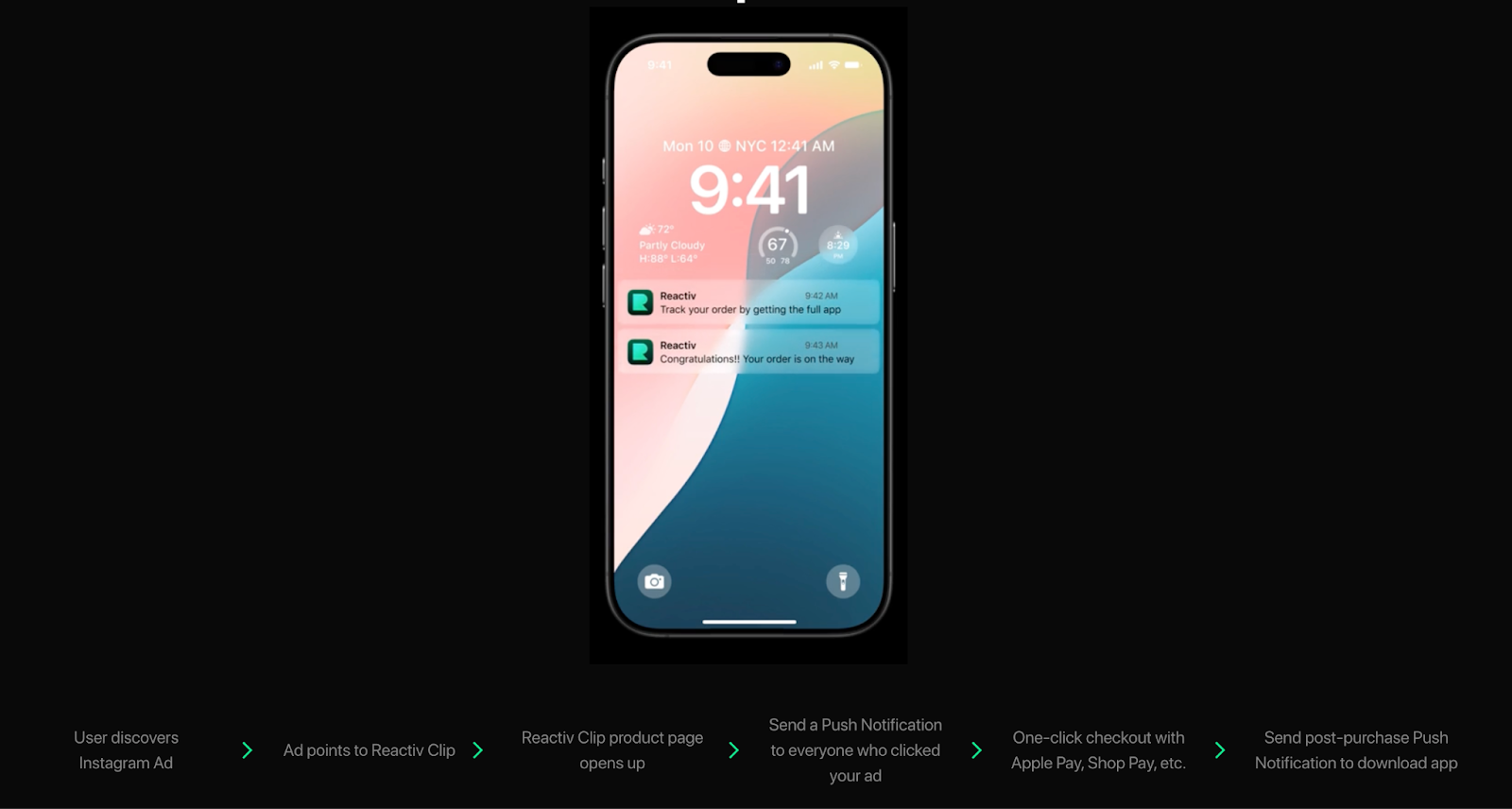
And when done well, they really work. The average user on Reactiv sees a 60% open rate on personalized pushes and a 5-7% conversion rate. Not to mention, they can receive up to 400% more engagement compared to untargeted campaigns.
A/B test in-app CTAs
If users don't notice or respond to your calls-to-action (CTAs), conversion opportunities slip away. But even small tweaks can drive meaningful gains!
Personalized CTAs convert 42% more visitors into leads than untargeted CTAs. This means that when building retargeting ads for different segments, you’ll want to strategically tailor your CTA to the relevant funnel stage like this:
- Strategic placement. Place CTAs above where users need to scroll and in high-intent areas like product detail, cart, and checkout screens.
- Actionable, benefit-driven copy. Use language like “Buy Now,” “Unlock Reward,” “Start Free Trial” that emphasizes the user's immediate benefit.
- Design for attention. Use contrasting colors and readable, mobile-friendly buttons.
- Time-based triggers. Surface CTAs during drop-off moments. For instance, using “Still thinking it over?” can help retarget abandoned flows.
- Test, track, and iterate. A/B test CTA placement, color, copy, and size. Measure both micro-conversions (clicks, feature engagement) and macro-conversions (purchases, sign-ups).
You can build and save multiple Landing Pages in Reactiv—each with its own layout, content, and deep link. This allows you to:
- Run simultaneous campaigns
- Tailor messaging for different audiences
- A/B test page layouts or offers
Experiment with app-exclusive offers
If your conversion rates aren’t where you want them to be, the perceived value of your app may not be high enough, or customers aren’t interested in what you’re offering.
One of the biggest advantages of a mobile app is that you can deliver exclusive, behavior-driven offers that websites and email campaigns can’t match.
The goal at this stage is to prompt immediate action with value-driven nudges while rewarding loyalty. Here are some examples of how to do so:
- Welcome discounts for new users. Encourage installs and account creation by offering 10–15% off the first in-app purchase.
- App-exclusive drops & early access. Build urgency with limited-time offers only accessible in the app.
- Behavior-driven rewards (via Reactiv In-App Offers). Trigger offers when users complete valuable actions like logging in, creating an account, or making a repeat purchase. This reduces churn and encourages deeper engagement.
- Frictionless redemption. With Reactiv, discounts apply automatically at checkout—no messy promo code entry.
- Secure & targeted incentives. Reactiv ensures discounts are tied to the right customer actions, so they can’t be shared broadly or abused like traditional promo codes.
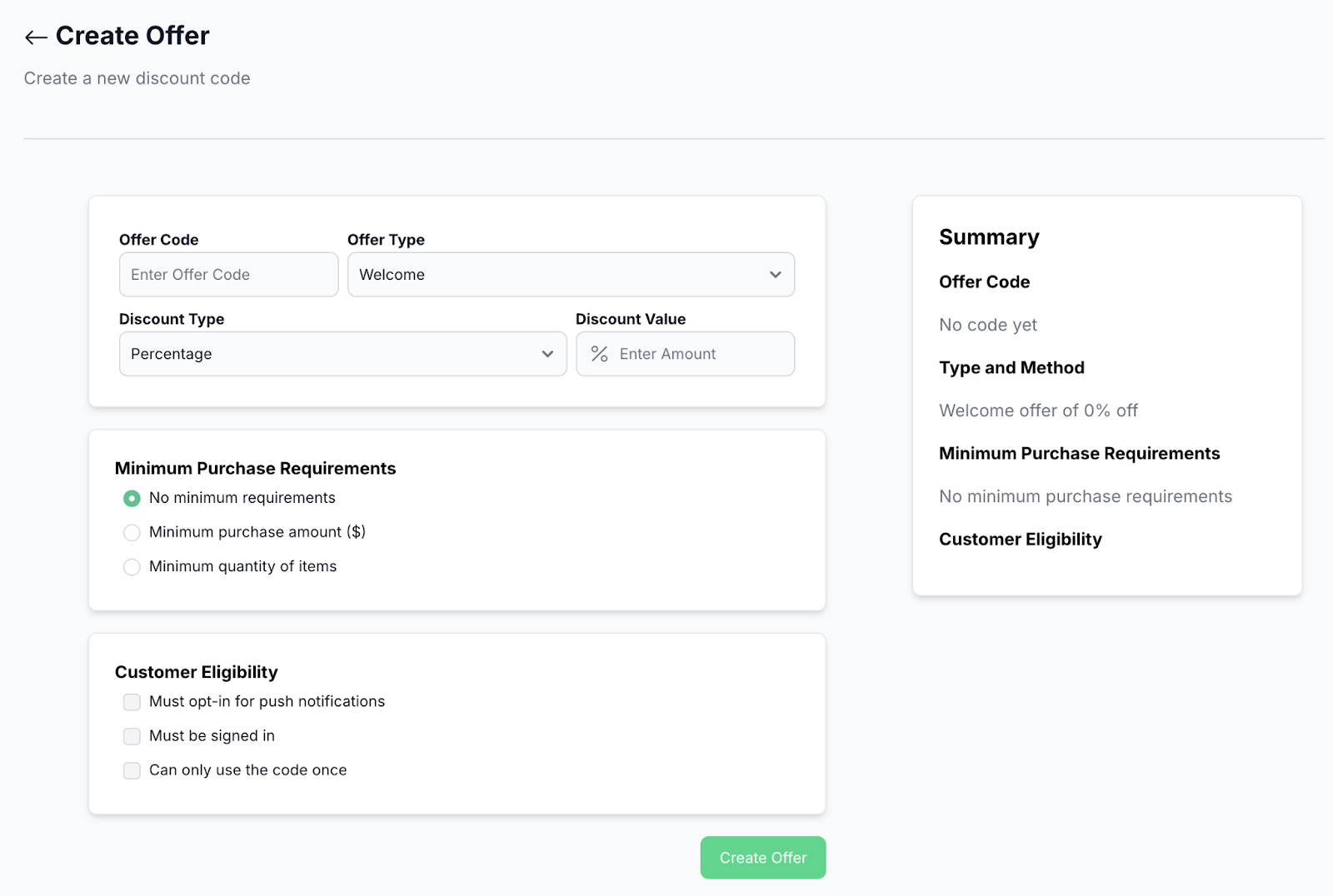
Reactiv Dashboard offers a powerful feature that allows you to configure special discount codes directly in your Shopify store.
- These discount codes can be provided to shoppers in your mobile app, enabling you to incentivize certain behaviors such as account creation.
- The offers you configure will automatically sync with Shopify and appear in the cart screen for eligible shoppers.
- To enhance security, the discount codes are obfuscated programmatically, reducing the likelihood of unauthorized sharing.
It’s simple:
- Choose the type of discount (e.g., percentage off, fixed amount off).
- Enter the discount value and any additional conditions (e.g., minimum purchase amount).
- Set the discount code that will be created in Shopify and obfuscated to prevent sharing.
Embed social proof and community throughout the app
Trust is a critical mover in conversion, especially when users are evaluating purchases. Social proof reassures them by showing they're not alone.
Data shows that 84% of consumers say they trust peer recommendations above all other sources of advertising.
When aiming to build trust and reduce hesitation, try implementing:
- Strategic customer review placements. Near CTAs, especially on product pages.
- Timely popups: Real-time purchase popups with language like “Someone just bought X!”
- Optimizing UGC. User-generated content (UGC) like customer photos or testimonials.
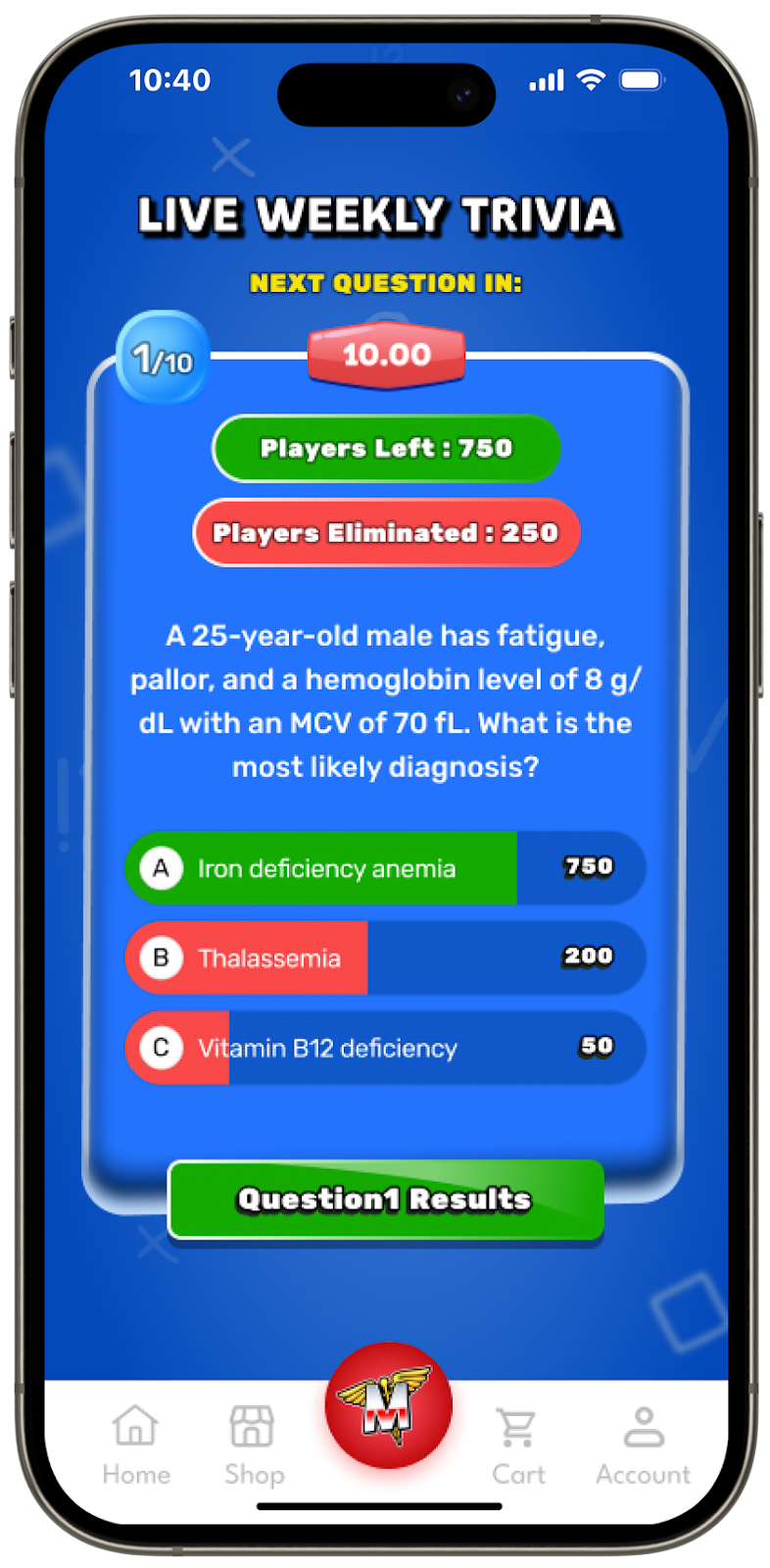
- Community engagement features. Quizzes or forums that build authenticity.
Take Med School Bro, an influencer brand that sells modern educational resources, study guides, flashcards, and PDFs to med students all over the world. The brand partnered with Reactiv to run quizzes in their app, where users can see how they stack up against other app users, building a sense of community and encouraging participation. Read more about this case here.
Make the checkout experience seamless
Even if your app nails onboarding, retargeting, and incentives, you can still lose conversions at the finish line. Why? A complicated or slow checkout flow.
The goal here is to reduce friction and make completing a purchase effortless. These are some tactics to ensure that goal is achieved:
- Incorporate express payment methods. Offer one-tap checkout options to simplify the most important part of the buying process.
- Minimize steps. Move toward one-page checkout flows where possible.
- Auto-fill details. Pre-fill shipping, payment information, and discounts for logged-in users to speed things up.
- Transparent costs. Show taxes, shipping, and fees upfront—no surprises at the last step.
- Post-purchase reassurance. Provide instant order confirmation and real-time tracking to build trust with the buyer
Boost your mobile app conversion rates with Reactiv
If you want to compete in the mobile app world in 2025, optimization is a must.
Leverage personalized in-app experiences and behavior-driven offers to boost your app conversion rate and turn more users into loyal customers.
Book a Reactiv demo to see how Reactiv can help maximize your app conversion rate.




See Reactiv on your storefront.
Book a demo and we'll walk you through native apps and App Clips running on your Shopify store.