
Attention to Revenue: 5 Ways to Increase Your ROAS
Instead of sending shoppers through the usual mobile maze, Clips turn engagement into a conversion-ready experience instantly.
March 15, 2026
12 min read
In this article

Subscribe to Our Newsletter
Get mobile commerce insights. No fluff, just what you need to build smarter.

Let’s be honest, watching revenue roll in feels good.
You launch a campaign, sales start coming through, and the dashboard looks… decent. But then comes the question, “Could this be working harder?”
Because more revenue doesn’t automatically mean better performance.
In ecommerce, attention is rented. Every impression, click, and visit costs something. And if that attention doesn’t convert efficiently, you’re not just leaving money on the table, you’re paying for missed opportunities.
That’s where Return on Ad Spend (ROAS) comes in.
ROAS 101: What is it and how to measure it
ROAS is more than a performance metric, it’s key to understand how efficiently your advertising turns attention into revenue. But increasing ROAS is more than lowering costs, it’s about optimizing the entire customer journey, from first impression to repeat purchase.
It measures the amount of revenue per dollar spent on advertising, key to understanding the efficacy of your digital advertising efforts.
So you launch a campaign and later, the numbers roll in: $10,000 in revenue from $2,500 in Meta ad spend. On paper, it looks like a win….but how much of a win.
The formula is straightforward: ROAS = Revenue from Ads ÷ Ad Spend
In this case, $10,000 divided by $2,500 gives you a 4:1 ROAS. For every dollar spent, four are returned. But the story doesn’t end there.
ROAS measures advertising efficiency, but doesn’t give you the full picture of total business health. A 4:1 ROAS may look impressive, but if 60% of revenue disappears into the cost of goods sold, shipping, and fulfillment, margins shrink quickly and that win starts looking a bit sad.
ROAS vs. Profit ROAS isolates ad performance, while profit accounts for everything, production, logistics, overhead. ROAS measures efficiency, while profit will tell you about sustainability.
ROAS vs. ROI ROI zooms out to evaluate the total cost of an initiative. ROAS zooms in, focusing exclusively on advertising spend effectiveness.
ROAS vs. CPA CPA narrows even further, calculating the average cost to acquire one customer offering a more holistic view of the overall efficacy of digital advertising.
Breakeven ROAS
Beyond just the ROAS, your breakeven ROAS is just as, if not, more important. This is the minimum return required to cover all costs. Before launching any campaign, brands need to know this benchmark. Without it, even strong-looking performance can quietly erode margins.
What looks like just a simple formula, ROAS in practice becomes an advertising strategy guideline. And it works best when you understand what it reveals, and what it leaves out.
ROAS benchmarks for ecommerce
Okay so "What counts as a “good” ROAS?”
The caveat with this is that there's no universal number to go by and call it a day. A “good” ROAS depends heavily on your industry, your margins, your ad platform, and even your campaign objective.
There is no one-size-fits-all standard to aim for, but there are benchmarks to see how you measure up to brands similar to yours.
In 2026, ecommerce performance paints a wide spectrum:
- Average ecommerce ROAS (industry-wide): 2.87:1
- Median ROAS across brands: 2.04:1
- Shopify’s recommended ROAS for profitable scaling: 4:1
- Top 10% of ecommerce advertisers: 8.4:1
That’s a significant range. A 2.87:1 return might be perfectly sustainable for one brand and completely insufficient for another. It’s not about chasing the highest number but to find your competitive context.
Here’s where analytics platforms like Triple Whale step in. As a leading ecommerce intelligence platform, it breaks down ROAS benchmarks by both industry and ad platform, helping brands move from generic averages to meaningful comparisons.

Source: Triple Whale
How strategic retargeting influences ROAS
One of the most common mistakes ecommerce brands make is surprisingly simple: they launch a campaign, watch the traffic roll in, and then… move on. You can’t just move on, think of a breakup you gotta do a bit of creeping before you move on. See if there's anything left first so in this case any potential customers who showed interest see if there’s potential for rekindling.
You need to keep the lines open, let them know they can always come back.
And that’s the beauty of retargeting.
Retargeting re-engages people who have already visited your website or mobile app, serving paid ads tailored to where they left off in their journey. And the performance difference is significant.
Retargeted ads often deliver 5–10x higher ROAS compared to cold traffic campaigns. On Meta, retargeting campaigns can generate a 65% uplift in ROAS, increasing returns from roughly 2.19:1 to 3.61:1.
IF you like numbers then here’s one, users are 70% more likely to convert, because the messaging aligns with their demonstrated intent.
Retargeting recaptures momentum. Because in digital advertising, the first click rarely tells the whole story but the second one often closes it.
5 ways to improve your ecommerce ROAS
“How do you push it higher sustainably?”
1. Use first-party data to sharpen targeting and recover lost revenue
Targeting isn’t what it used to be. Privacy updates have made ads more expensive and less accurate. At the same time, nearly 70% of filled carts are abandoned, contributing to an estimated $18 billion in lost sales annually.
So basically you’re paying more to acquire customers while revenue quietly slips away, doesn’t really sound like a good deal at all.
Zero and first-party data fixes both problems at once: you leverage the data customers willingly give you, sharpening your targeting while re-engaging shoppers who were already close to converting.
What to do:
1. Build first-party audience lists from your email subscribers, prior purchasers, and high-value segments to platforms like Meta and Google as custom audiences.
Shopify Audiences has helped ecommerce brands reduce customer acquisition costs by up to 50% Some have even doubled their retargeting conversion rates compared to traditional interest-based targeting.
2. Use those audiences as seed data for lookalike campaigns. Because they’re built from real buyers, they typically perform far better than broad interest targeting.
But acquisition is only half the opportunity. Cart abandoners represent high-intent shoppers who simply didn’t finish the transaction.
3. Run a multi-channel recovery flow. Brands that connect email, SMS, and push often recover around 12% of abandoned carts.
Without jumping straight to offering a discount.
4. Test urgency or FOMO-driven messaging first. “Only 2 left” or “Selling fast,” preserves margin while still driving conversion and even increasing your ROAS.
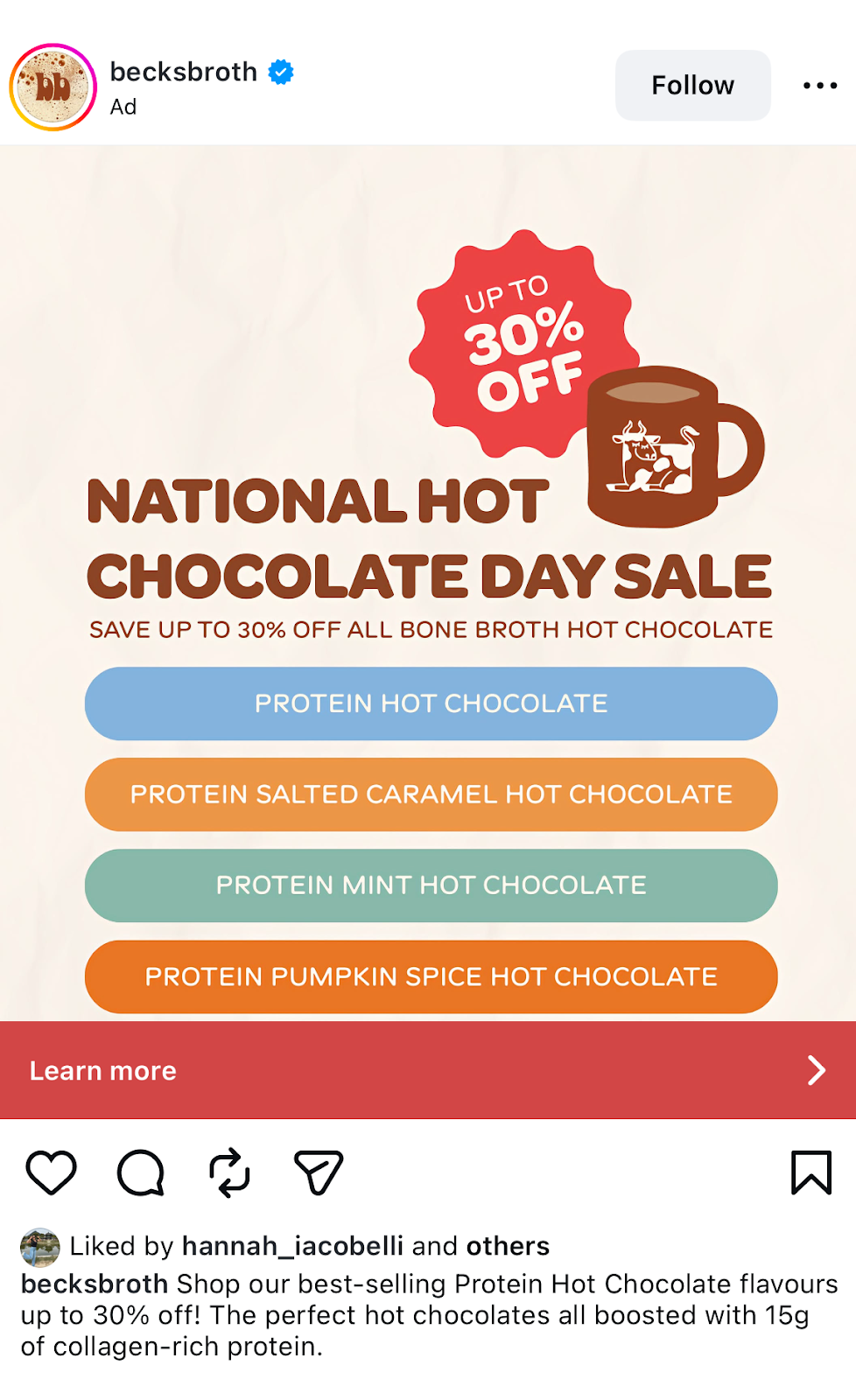
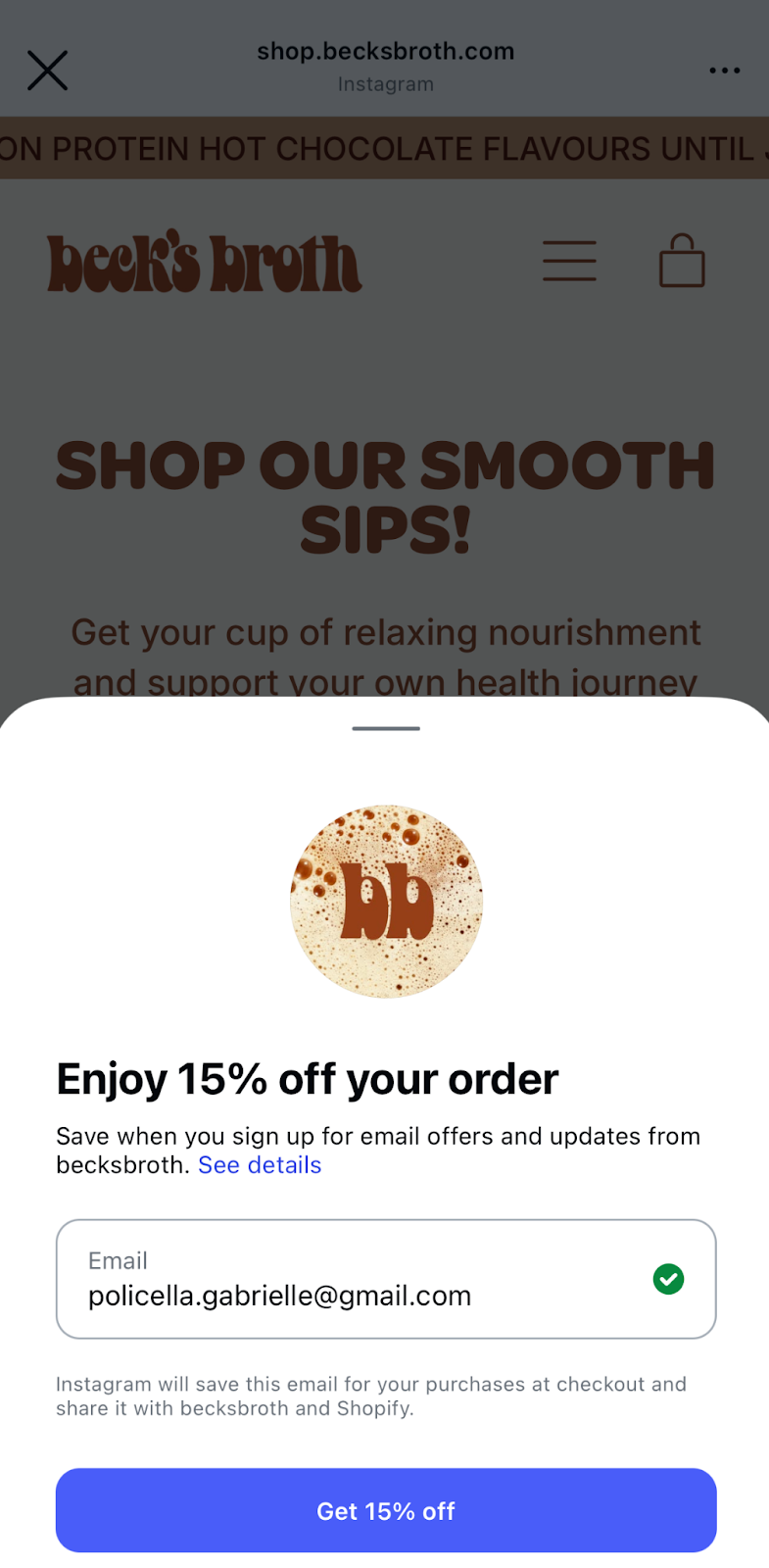
Consider the example of bone broth brand Beck’s Broth. The brand retargets both cart and browse abandoners with segmented Meta ads. A shopper who previously viewed its protein hot chocolate might later see a tailored Instagram ad reinforcing that product. When they click, they’re prompted with a 15% welcome offer in exchange for an email subscription.
This strategy brings back the sale, grows the email list, and makes future targeting even stronger.
2. Optimize your ad campaigns; from creative to targeting to bidding
This is where most ecommerce brands pour their energy, and it does matter.
But optimization only works if it’s intentional.
Too often, brands make sudden changes, chase short-term fluctuations, and call it strategy. Constantly tweaking things based on short-term results isn’t a strategy. But testing with intention is. . and here is where it starts:
Ad Creative
Creative is often the biggest performance driver. A stronger hook or sharper visual can double results without changing audience or spend.
Run simple A/B tests over short windows (around two weeks) and change one variable at a time. Test one headline against another and experiment with different CTAs. Explore carousels, short-form video, and dynamic products to see how they perform at various funnel stages.
Targeting: Relevance Over Reach
Broad targeting can feel scalable, but it often waters down performance.
Instead, test high-intent behavioral segments like cart abandoners, product page viewers, repeat visitors. These people have already shown interest. When the message matches that intent, conversions follow.
Read more about retargeting here.
Bidding
Most platforms allow you to set target ROAS goals.
Set your initial target at or slightly below your current average ROAS. This gives the algorithm room to learn while maintaining realistic efficiency expectations. Once results level out, you can slowly raise the target.
When it comes to ad strategy, consider skincare brand Blume. The brand promotes the same 30% discount on its Clear Skin Kit across multiple Instagram ads. The offer stays the same but the framing changes.
One ad leans into social proof and encourages users to “Learn more.” Another invites customers to “Try something new.” The same product and discount, just positioned differently.
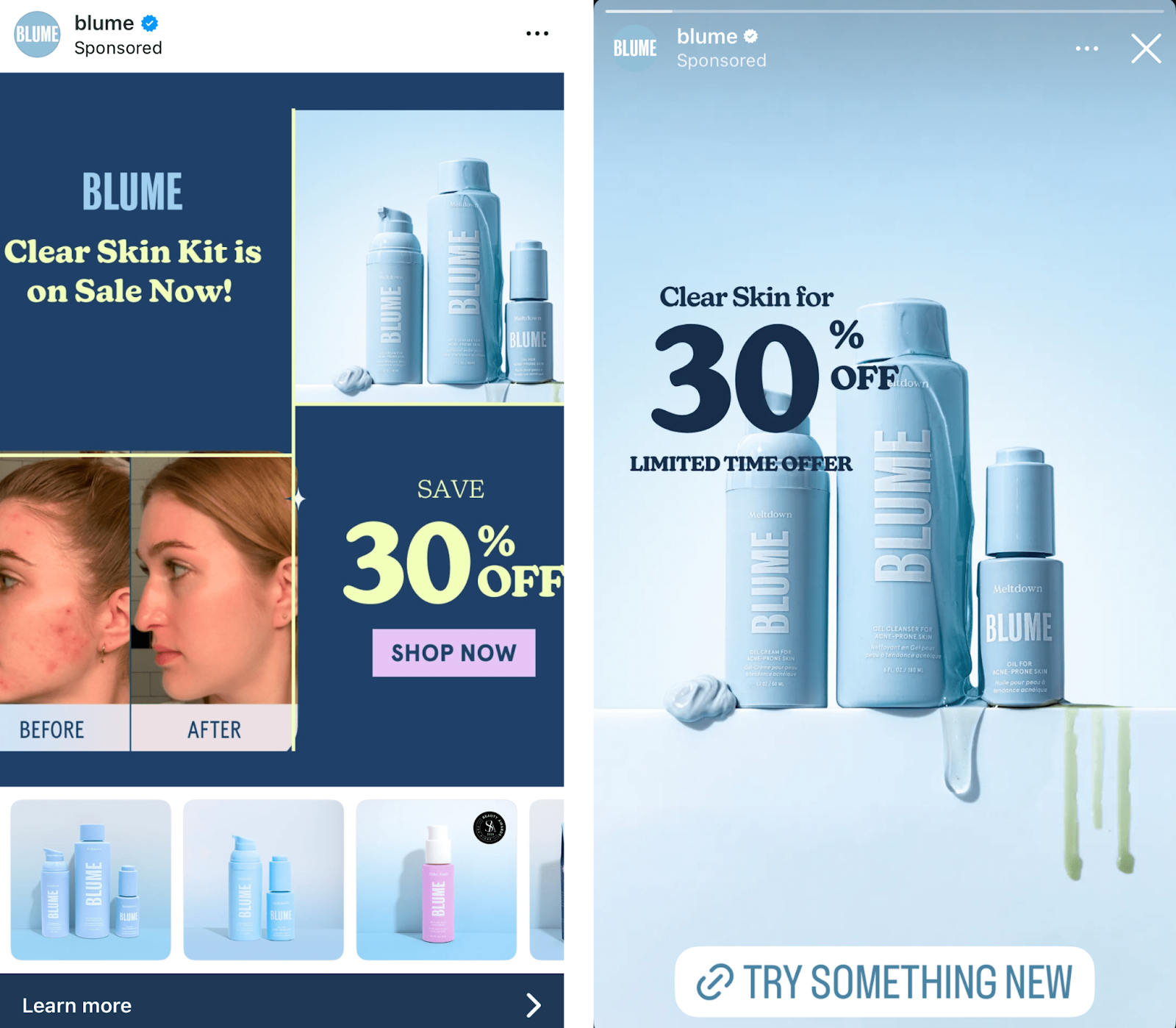
That’s strategic optimization: refining how the message lands.
3. Fix the post-click experience
Most brands obsess over the ad…But then they send high-intent traffic to a landing page that only kills the momentum.
This is where the biggest ROAS leaks happen.
Mobile devices now account for 83% of ecommerce traffic, but yet mobile landing pages convert 8% worse than desktop. That gap? That’s friction.
Mobile users behave differently. Meaning now more than ever, specific mobile app conversion strategies are key.
Okay so how are we doing this:
Match Ad to the Message
Nothing makes someone bounce faster than a disconnect between the ad and the landing page.
If your ad promotes a specific pair of shoes, the click should lead directly to that product page, not your homepage or general collections page.
Every extra step gives them a reason to hesitate, and hesitation kills conversions.
Ruthlessly Cut Friction
Make mobile checkout as effortless as possible. Use pre-filled forms, offer a single-page checkout, enable mobile wallet payments like Apple Pay or Google Pay, allow guest checkout, and remove unnecessary fields.
Because 65% of shoppers abandon at checkout, and nearly half of those exits (48%) happen due to unexpected costs.
By the time someone reaches checkout, you’ve already paid to acquire them. At that point, it’s not just a UX issue. It’s a ROAS problem.
Design Mobile-First, Not Mobile-Adjusted
If most of your traffic is mobile (and it likely is), your landing page shouldn’t be a shrunken desktop experience. It should be designed for thumbs.
Make your CTAs easy to find, ideally where the thumbs naturally pause while scrolling, keeping layouts clean.
Consider how Gap approaches this. The brand runs carousel ads on Meta featuring products based on a shopper’s previous browsing behavior, purchase history, or cart activity. When a user clicks a specific item, they land directly on that exact product page.
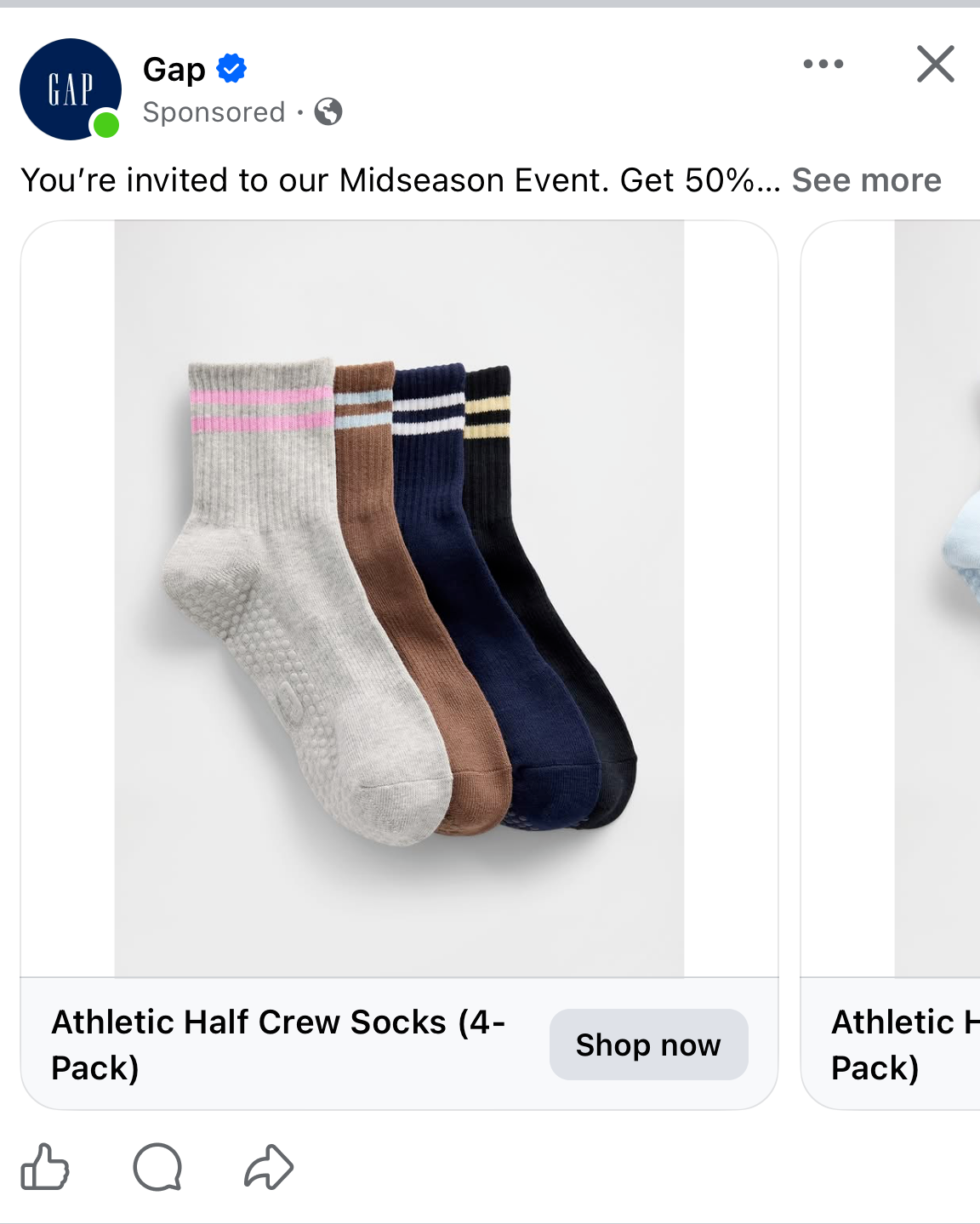
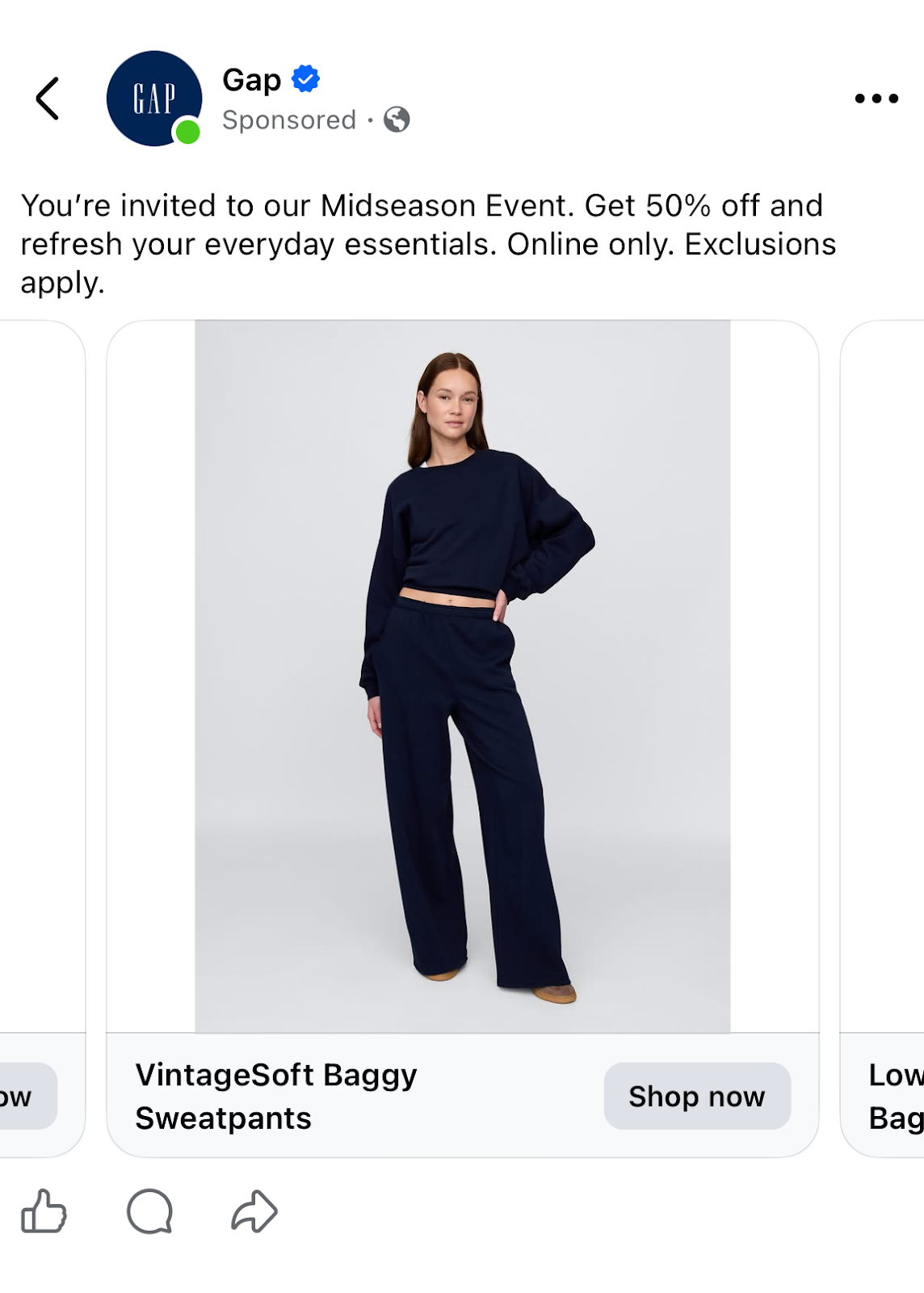

When there’s no searching or guesswork, the experience feels effortless and without burden. When you’ve already earned the click, your job should be to make conversion the easiest possible next step.
4. Increase AOV and think in terms of LTV over one-time purchases
There are only two ways to improve ROAS: spend less or earn more. Most brands obsess over the first. The smart ones work on the second.Increasing average order value (AOV) and customer lifetime value (LTV) allows you to grow revenue without increasing ad spend.
But also, it gives you strategic flexibility. If you know a customer will stick around, you can afford to ease up on first-purchase ROAS, because the real return comes later.
How to increase ROAS through higher AOV:
Start with free shipping thresholds.
Set them 15–20% above your current AOV so adding one more product feels like the obvious move. Next, surface product bundles directly on your landing pages.
Show “Frequently Bought Together” suggestions or curated best-seller kits that, when done well, naturally encourage larger cart sizes.
And don’t stop once they hit “Place Order.”
Post-purchase upsells
Use your confirmation page and follow up emails to offer one more relevant add-on. No extra ad spend required.
But how does increasing LTV raise ROAS?
LTV changes the entire equation
Repeat customers spend 67% more than new customers. That means the value of acquisition compounds, and isn’t confined to a single purchase.
Start treating your best customers like your best customers.
Your top customers often drive a disproportionate share of revenue. Allocating a budget toward re-engaging them can generate stronger returns than constantly chasing new audiences.
Build loyalty touchpoints into your campaigns.
Use tactics like replenishment reminders, win-back campaigns, and new release campaigns to convert at higher rates and at lower cost. In turn, for higher ROAS.
Don’t overlook app adoption.
Brands with mobile apps see up to 50% higher repeat purchases compared to those without. Running campaigns that drive app downloads can indirectly strengthen retention and in turn long-term ROAS.
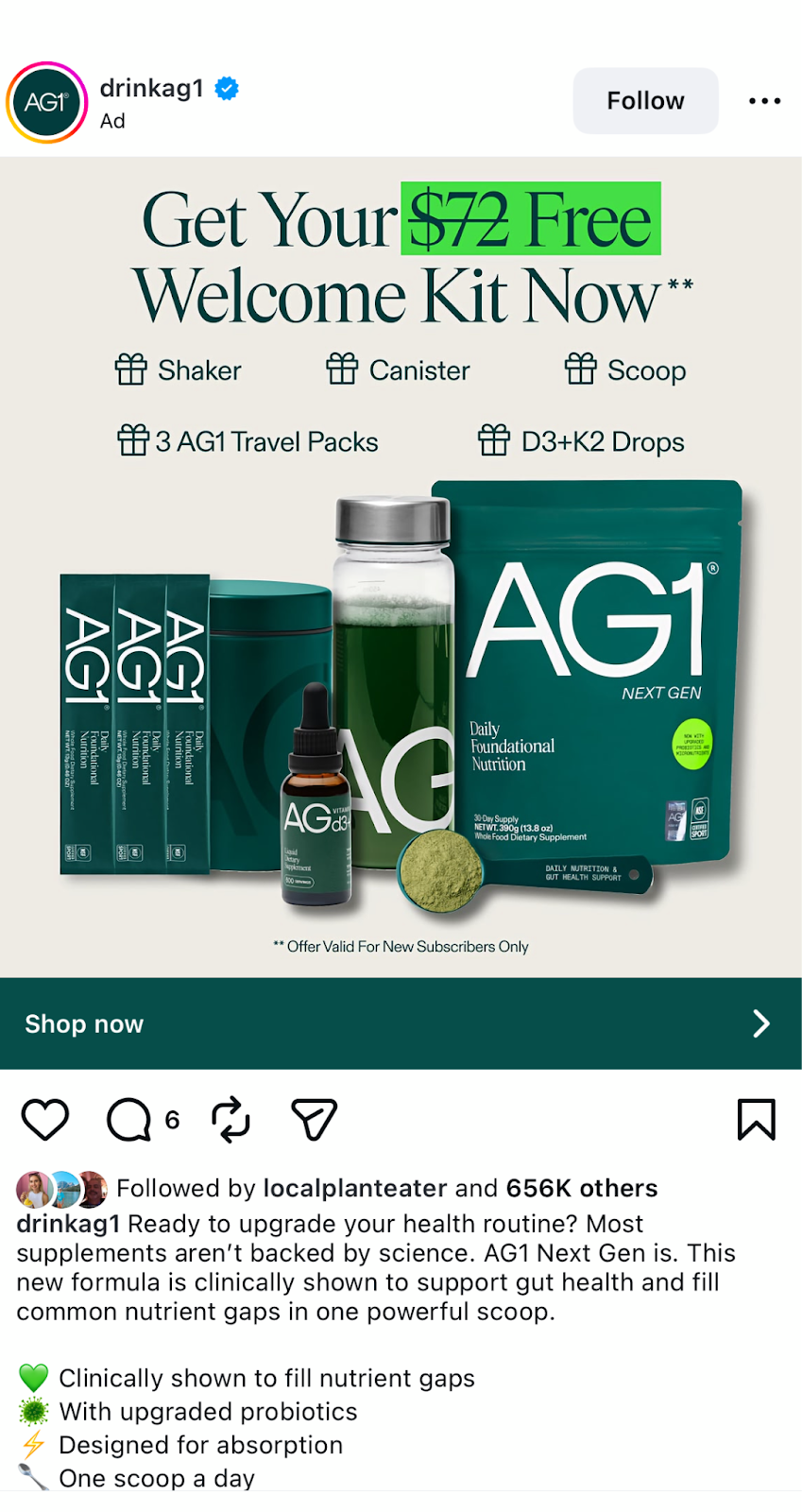
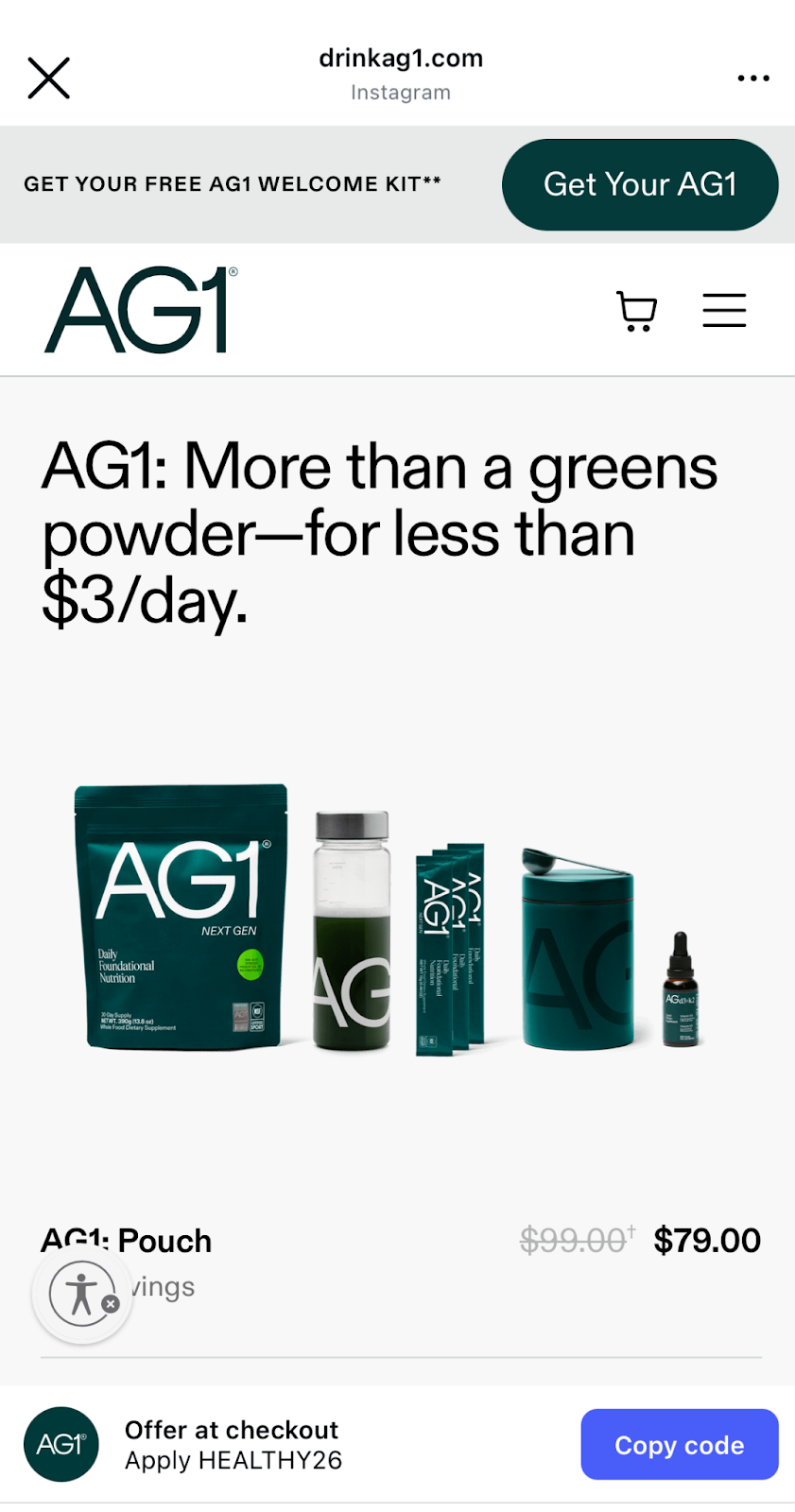
Consider AG1’s approach to increasing AOV. The brand promotes a free starter kit valued at $72 to encourage first-time purchases. The catch is to unlock the offer, customers must spend $79 on a 30-serving supply of its flagship product.
This tactic boosts the first order and quietly builds the habit that drives the next one.
5. Retarget mobile users through app-like experiences with Reactiv Clips
Most ROAS advice starts at your website. But what about everyone who never makes it there?
For instance:
- Someone watches your video ad, but doesn’t click.
- Someone clicks, but bounces from a slow mobile landing page.
- Someone interacts, but never completes checkout.
Here’s the problem: traditional retargeting only works if someone makes it to your site. If they don’t? They’re gone.
This is where Reactiv Clips close the gap.
Reactiv Clips bypasses the traditional landing page entirely. When someone taps a Reactiv push notification, they open straight into an app-like experience, no download, no App Store, no friction.
Here is how the flow changes:
- Initial Ad Engagement. A user interacts, but doesn’t convert or fully land on your site.
- Push Notification. The user receives a follow-up notification tailored to the ad they engaged with.
- Native App-Like Experience. The user enters an immersive, app-style interface with product pages, checkout flow, and purchase functionality.
- Purchase. The transaction happens directly within the Clip.
This model closes three performance gaps at once. It brings back users that your pixels never capture, it avoids the slow, leaky mobile pages that kill momentum, and it delivers an experience that feels like an app without having to download anything. Often the issue isn’t the ad itself but what's waiting on the other side of the click. Feel like something’s off with your running ads? Let's talk about it.
If you want to better understand how Reactiv Clips can work for you, listen to learn more.
Raise your ROAS with Reactiv
At every stage of the funnel, friction quietly erodes performance.
Instead of sending shoppers through the usual mobile maze, Clips turn engagement into a conversion-ready experience instantly. Users open into a fast, app-like flow with no download required. That means you can reconnect with the people most brands lose: video viewers who didn’t click, visitors who bounced, and shoppers who engaged but never finished.
Reactiv Clips are designed to close those gaps.
Because Clips reconnect with shoppers while their interest is still warm, push notifications see strong open and engagement rates even beyond typical opt-in windows.
Brands using Clips have reported higher conversion rates, recovered abandoned carts, and boosted AOV, driving up to a 20% lift in ROAS. And Reactiv can help show you how to calculate the profits.
If you want to improve ROAS without increasing ad spend, the opportunity might not always be at the top of the funnel. Sometimes it’s in fixing what happens after engagement, creating a higher-converting mobile path to purchase.
See how it works: Reactiv Clips demo


See Reactiv on your storefront.
Book a demo and we'll walk you through native apps and App Clips running on your Shopify store.