Get mobile commerce insights—no fluff, just what you need to build smarter.
Top 15 retargeting ads examples that successfully converted (with strategies you can steal!)

It’s a universal certainty: ads are everywhere. And today, there are more opportunities than ever for shoppers to see marketing messages, whether they’re checking emails or scrolling on social media.
As a result, a lot of marketing messages end up becoming white noise – like seeing another wise, bearded wizard in a fantasy movie (it’s been done).
So, how do you stand out?
The key is actually pretty simple: personalization. Hyper-personalized strategies allow you to run ads that are actually relevant to the customer. And today, we’re breaking down our favourite strategies: retargeting and remarketing.
Read on because we're breaking down our top 15 remarketing and retargeting ads examples to help inspire your strategy.
What is remarketing vs. retargeting?
Remarketing and retargeting are personalized marketing approaches that focus on customers who visited your website or mobile app but did not take a specific action.
Although both terms are sometimes used interchangeably, there are a few key differences:
- Remarketing involves reaching out to a customer whose information you already have. This can be through a previous purchase or an email list sign-up. The goal is to reach out through personalized channels like email, SMS, or push notifications to create customer loyalty.
- Retargeting focuses on customers who have visited your website but have not yet made a purchase. It uses cookies from when customers visit your site and then serves them ads once they leave your site on third-party websites like the Google Display Network or the Meta Audience Network.
BONUS: Track what’s actually working
Running retargeting ads without tracking profitability is like driving with your eyes closed. Just because someone came back to your site doesn’t mean the ad paid off.
To help you dial in your spend, we put together a free Ads Profitability Tracker Spreadsheet—built specifically for ecommerce teams.
You can use it to:
- Track ROAS across Meta, Google, TikTok, and other channels
- Compare retargeting vs. prospecting campaign efficiency
- Monitor performance by audience, creative, and funnel stage
- Make faster decisions on where to scale or cut back
15 top-tier remarketing ad examples for every stage of the customer journey
Time for the fun part! Here are 15 of the best remarketing ads examples we’ve seen.
1. Good Protein – pair social ad retargeting with welcome offers for first-time customers
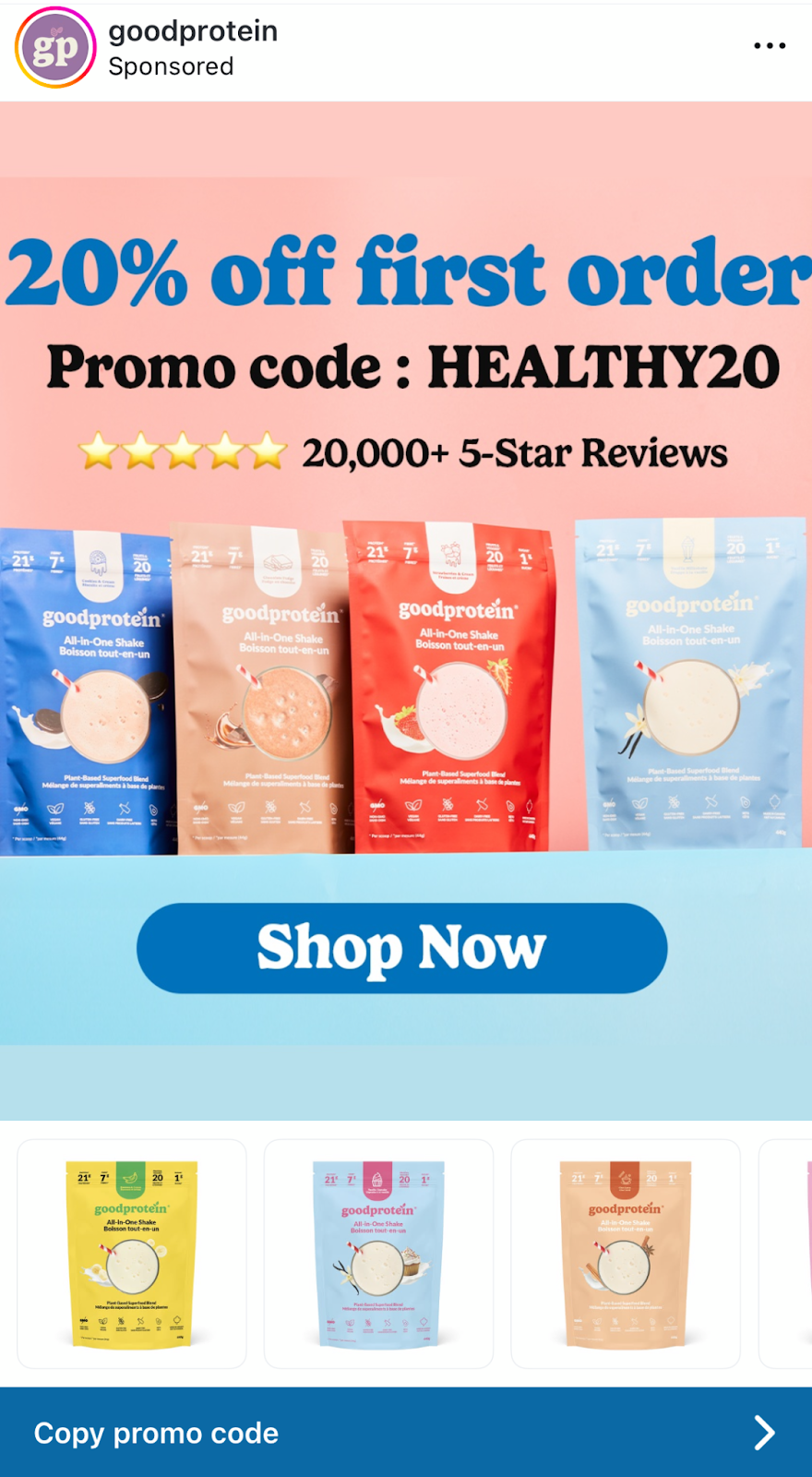
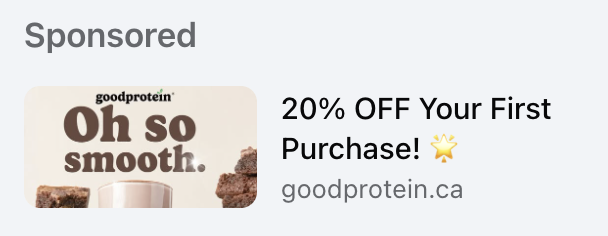
Good Protein’s approach was to use this collection ad to dynamically display products customers can click on. Customers are taken directly to the product page where they can learn more or add the item to their cart.
They also:
- Retargeted customers through the Meta Display network through Instagram Feed Ads and Facebook right column ads
- Offered first-time customers 20% off their first order to incentivize the first purchase
- Supplemented the discount with social proof by highlighting 20,000 5-star reviews
Top takeaway
Running ads across multiple channels keeps the offer top-of-mind. Varying the format, style, and imagery of each ad also prevents the customer from feeling ad fatigue or annoyance.
2. Sloane Tea – use carousel ads to show off your best-sellers
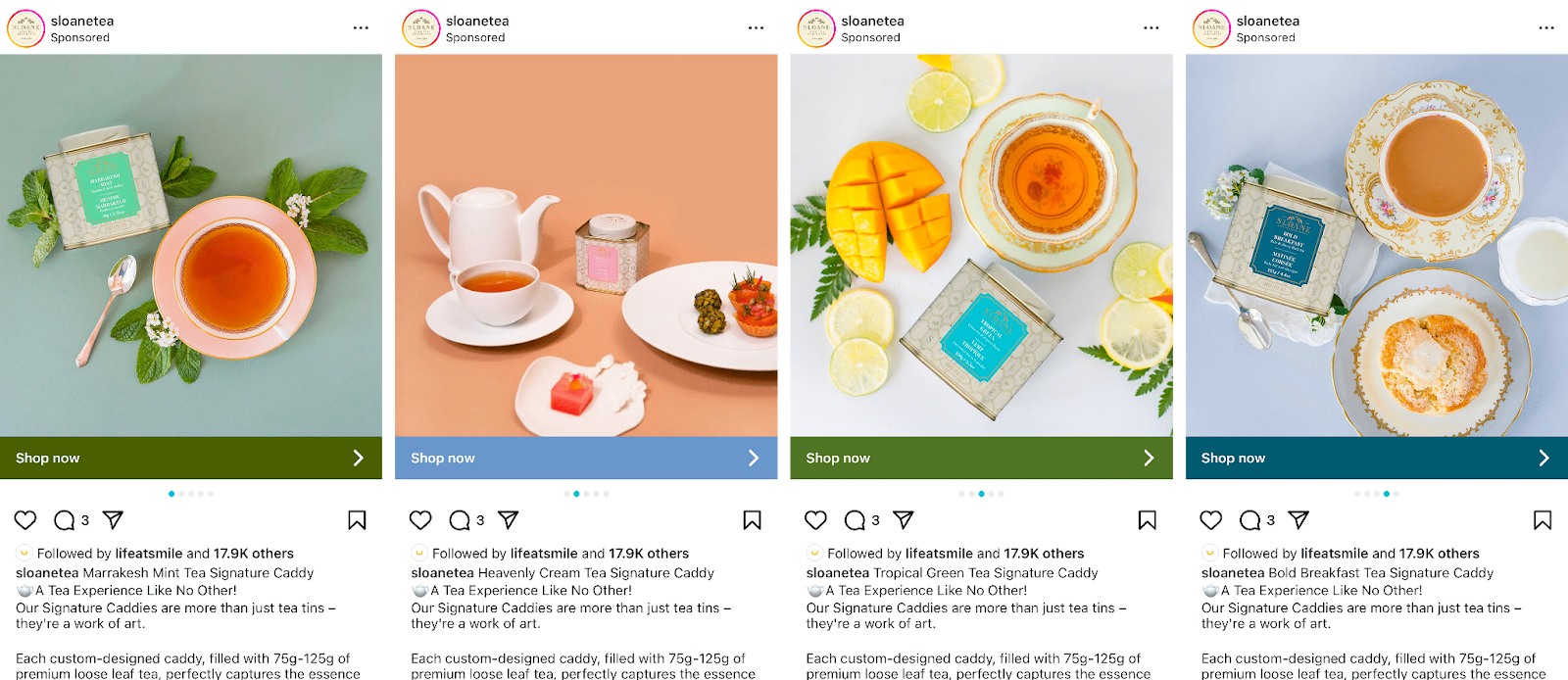
Sloane Tea used a dynamic social media carousel ad to highlight multiple products based on what the customer had viewed.
Each slide in the carousel features a different image and caption. Each image also has a “Shop now” CTA, making it easy for customers to visit the product page they’re most interested in.
Top takeaway
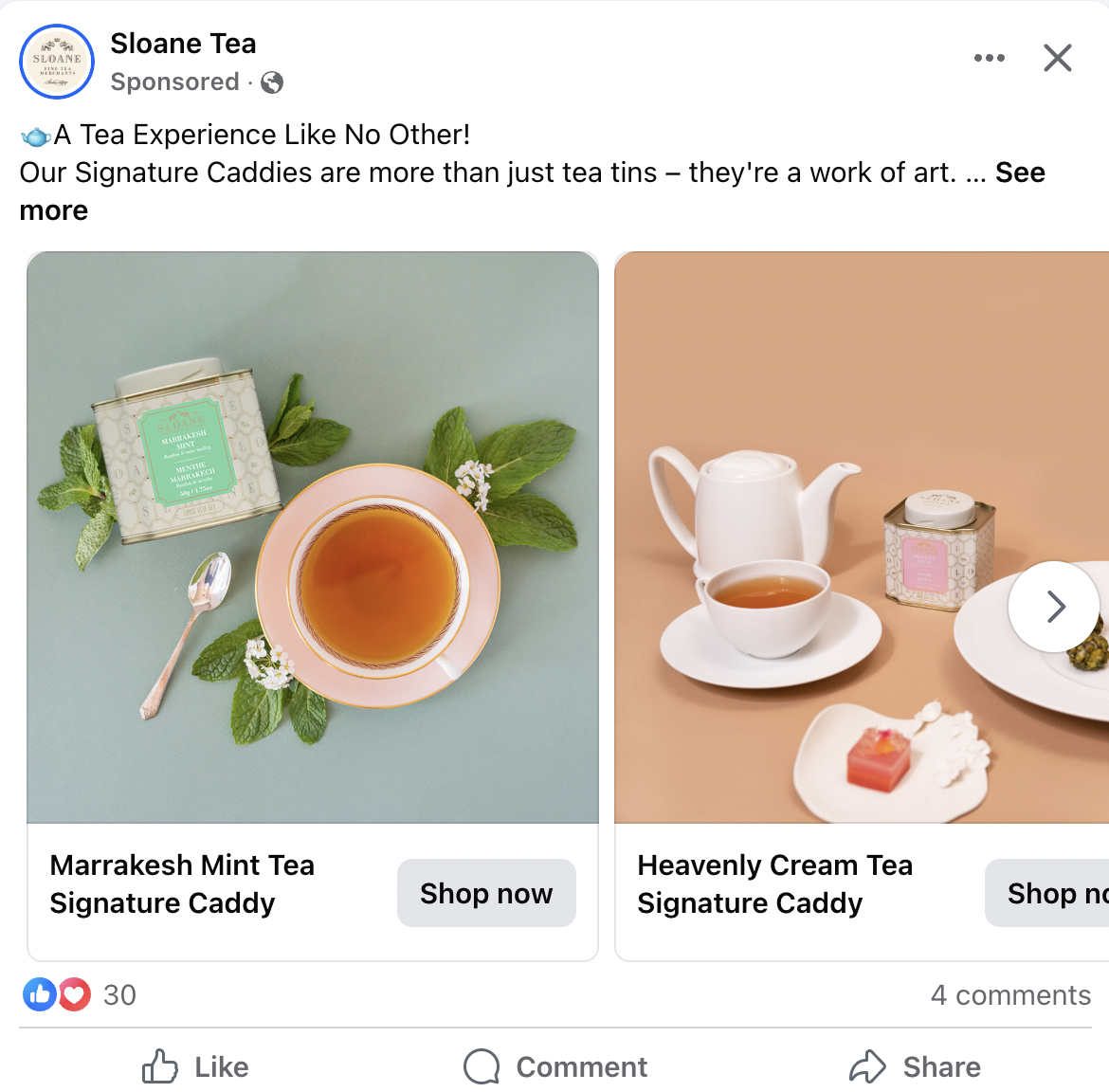
Sloane also wisely used the same ad format on Facebook to reach shoppers across multiple channels.
3. Journeys – bring customers back with display ads
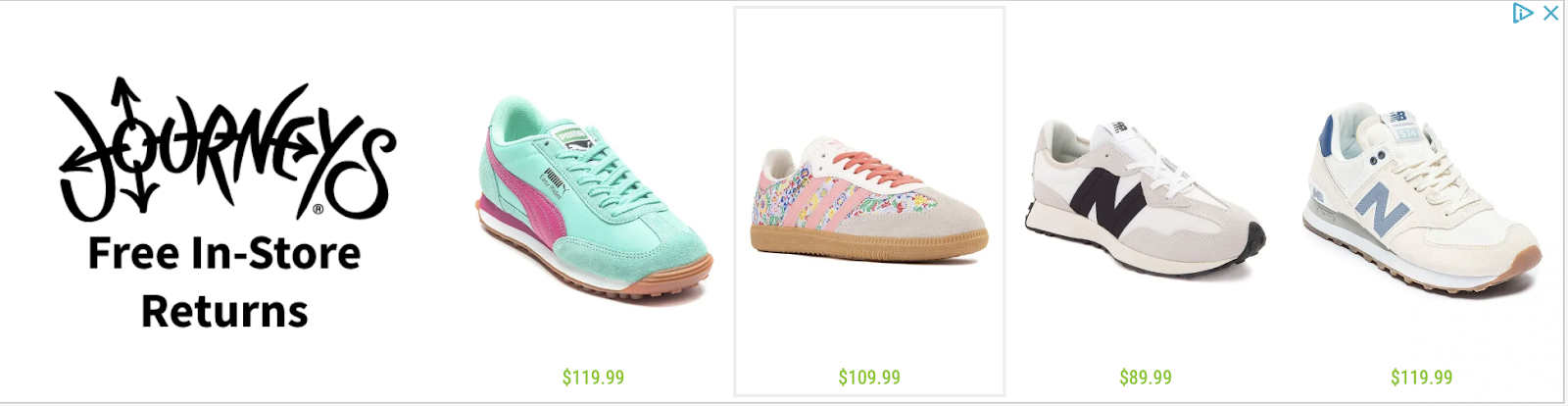
Journeys used this dynamic Google Display ad that shoppers see on a third-party site. The ad shows sneakers they were previously browsing or similar styles.
Top takeaway
Highlighting the price of each sneaker takes the guesswork out. Calling out “Free in-store returns” can help remove the risk customers feel with online purchases.
4. Arrae – drive conversions by retargeting customers based on their pain points
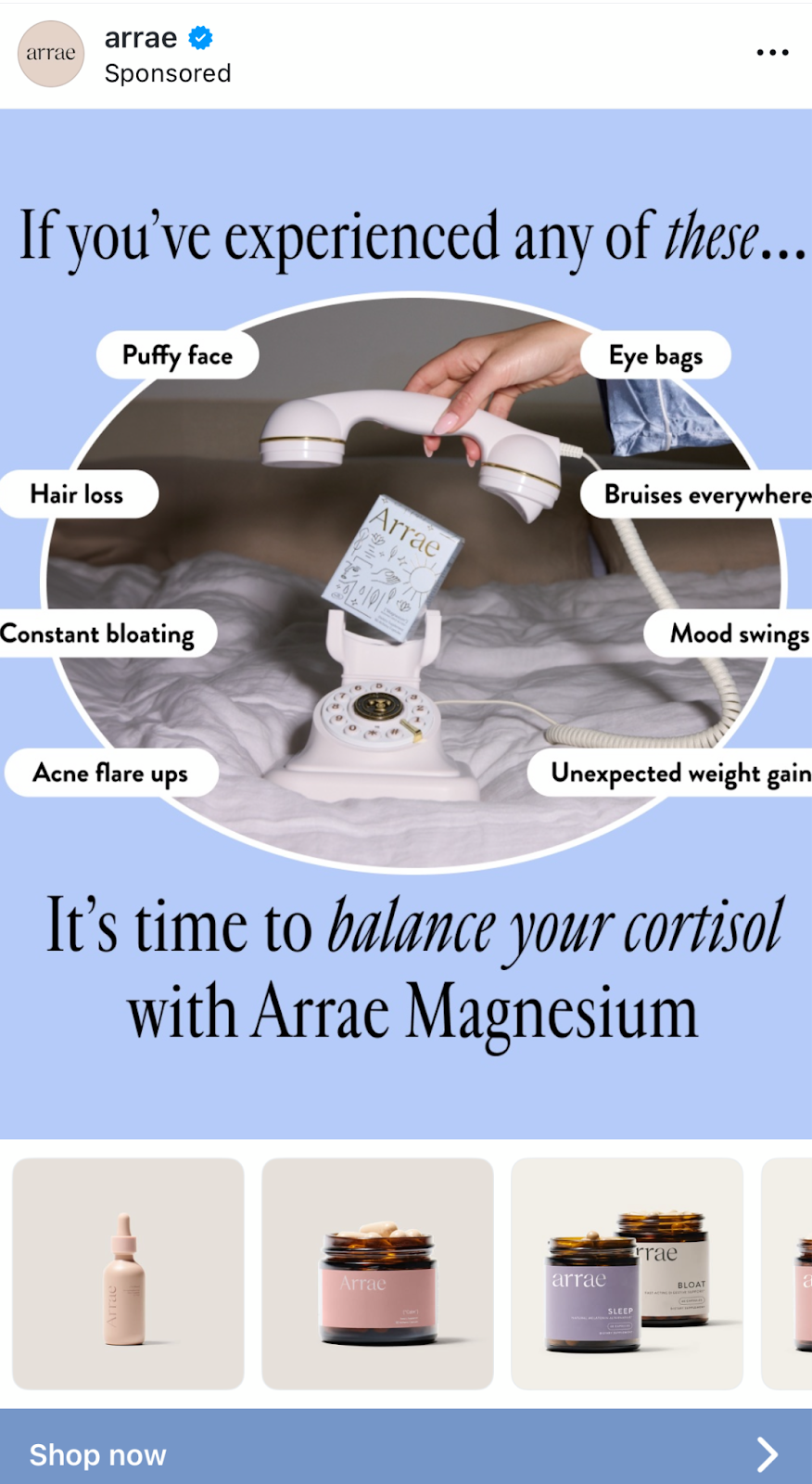
Arrae strategically retargeted customers through this Instagram Feed ad. They called out common symptoms of high cortisol and positioned their Arrae Magnesium as the solution.
It’s also a collection ad, so customers can click only on the product they’re most interested in.
Top takeaway
One of the most tried and tested ad formulas is the problem-solution approach, which Arrae has masterfully used in this remarketing ad example.
5. Levi’s – retarget past shoppers with new product releases
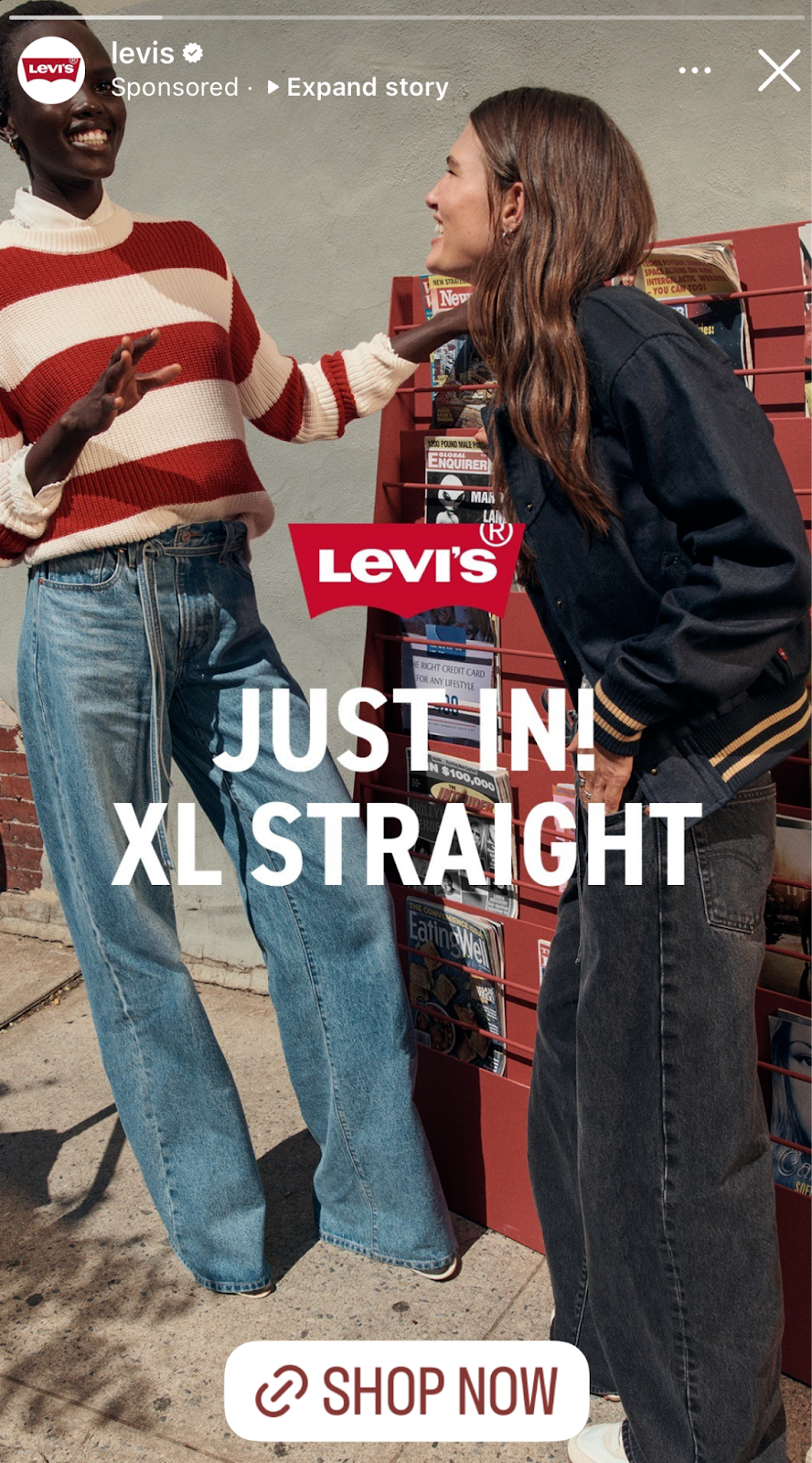
Social media retargeting can also work for customers who have shopped with you in the past, but haven’t returned in a while.
For example, Levi’s used this Instagram Story ad to serve a message about their new product drop. This creates excitement and has a clear call to action.
Top takeaway
Don’t underestimate the power of imagery. Using lifestyle photography makes this ad feel natural in the story feed and non-disruptive to the shopper’s experience.
6. Blume – inspire customers with social proof
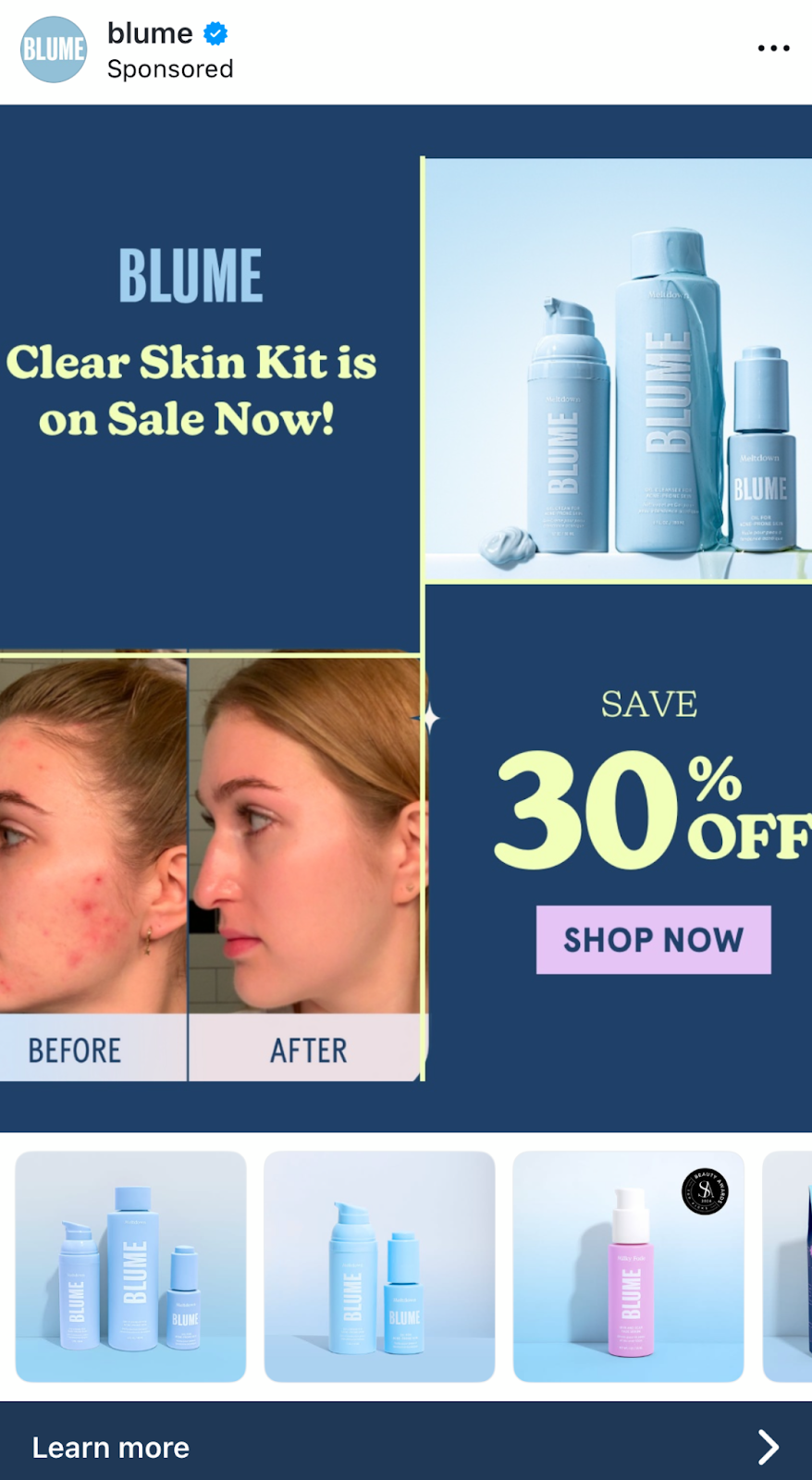
Customer reviews and testimonials are one of your most effective marketing tools. Blume did a great job of using these through its Instagram ad for its Clear Skin Kit.
This ad highlights real before and after pictures from a customer to show how effective the product is at targeting acne and scarring.
Top takeaway
Combining this ad with a 30% off discount goes a long way to helping shoppers who are on the fence commit to making a purchase.
7. Hush Blankets – take an omnichannel retargeting approach to stay top of mind
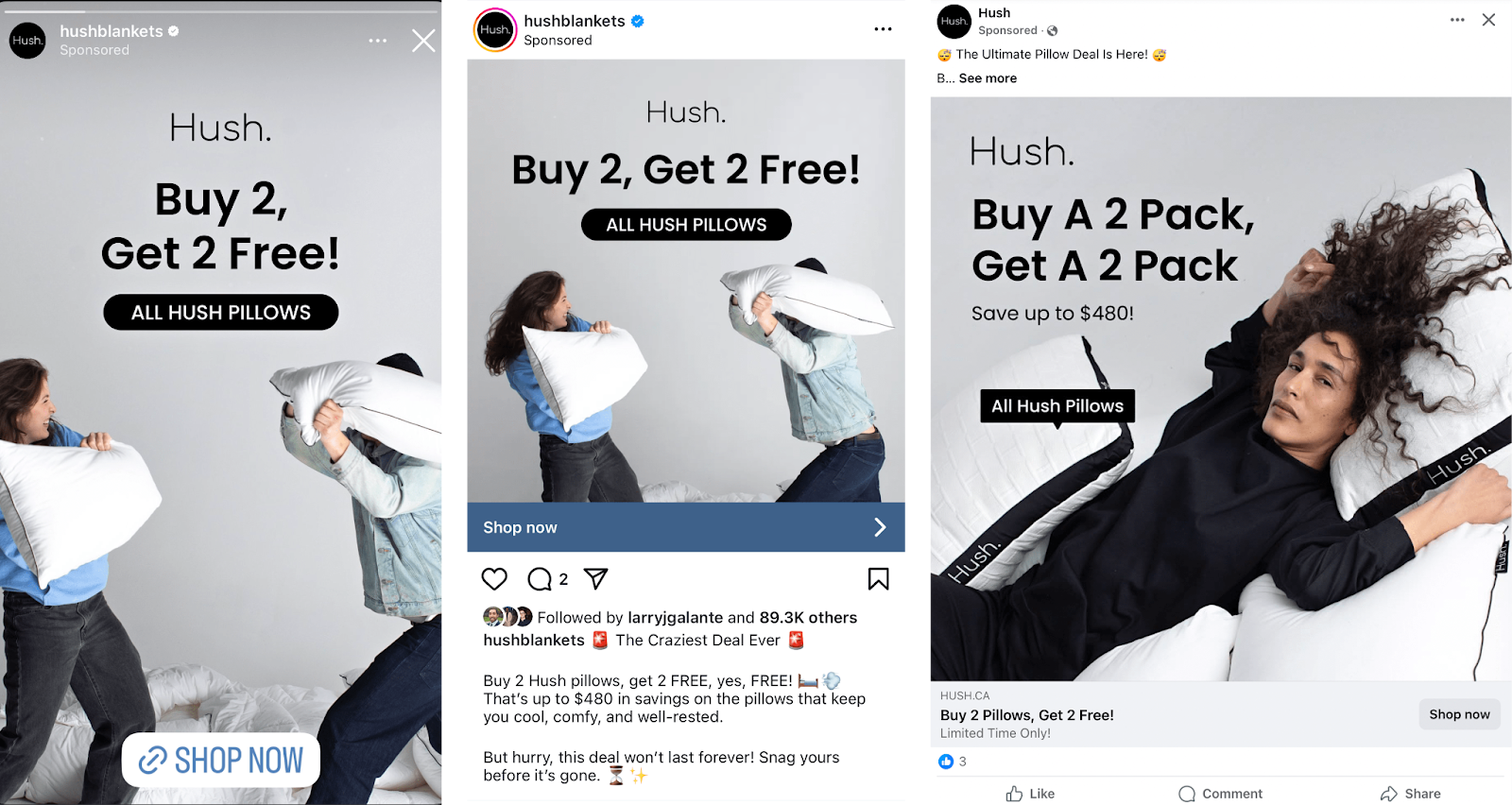

Hush Blankets’ recent “Buy 2, Get 2 Free” pillow campaign was the perfect example of balancing retargeting and remarketing. They used a combination of Instagram Story, Instagram Feed, and Facebook Feed ads through the Meta Ad Network.
To keep things interesting, each ad used slightly different sizes, images and captions while maintaining a consistent message of “Buy 2, Get 2 Free!” to create cohesiveness and brand recall. Hush also combined these retargeting ad examples with a personalized remarketing email with the same message but more information.
Top takeaway
Hush paired this ad with a personalized remarketing email that helped encourage the shopper to take advantage of the deal before it ends. Remember: personalization!
8. Loop Earplugs – create FOMO with limited-time-only deals
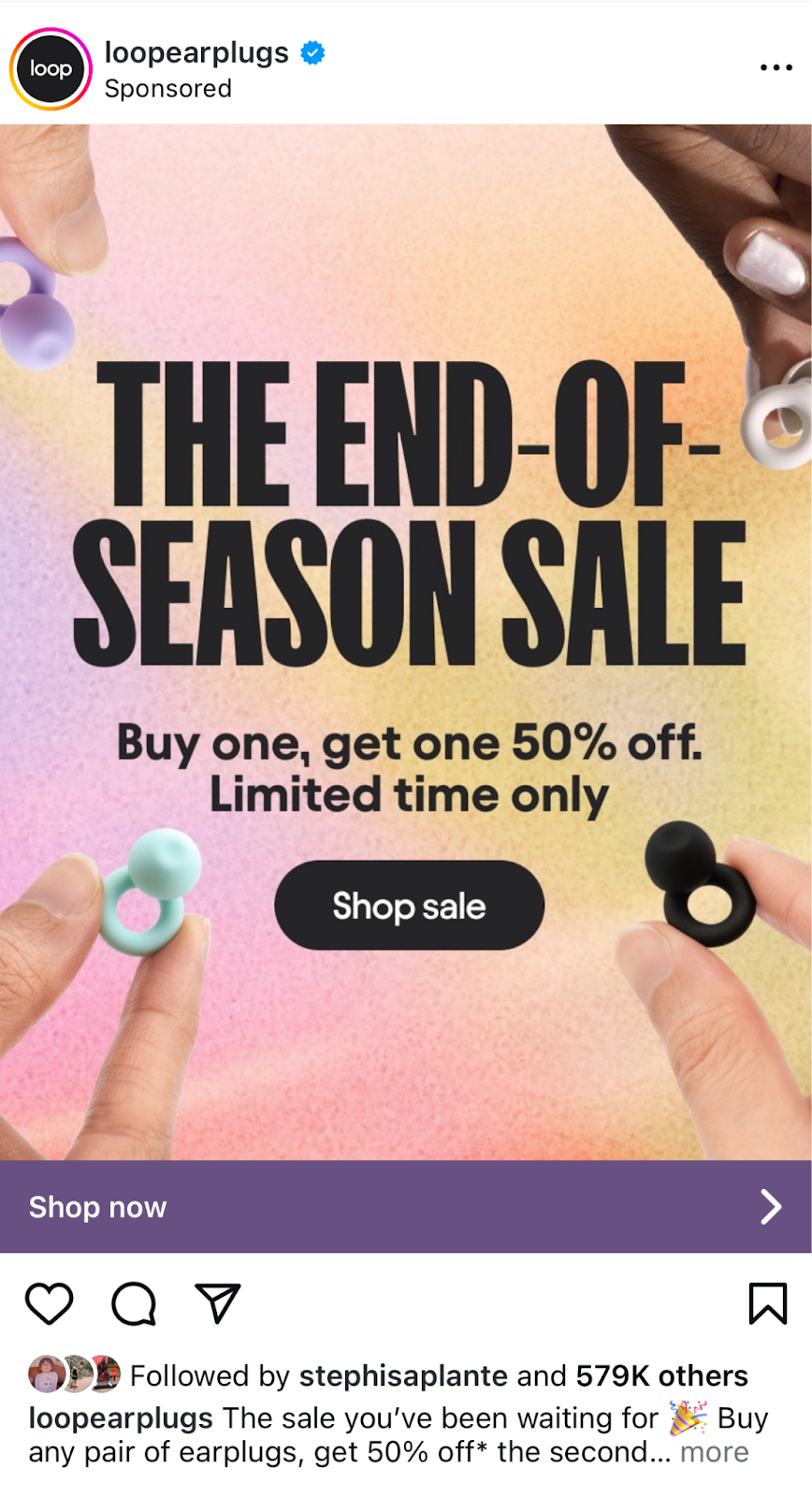
Loop Earplugs promoted a buy one, get one 50% off sale through this Instagram Feed ad. The idea is that customers who had browsed specific earplugs or added products to their cart wouldn’t want to miss out on this offer (hence the FOMO).
Top takeaway
Everyone loves a sale. Creating a sense of urgency with time-constrained offers is one of the best retargeting ad messages you can use.
9. Oak + Fort – recover abandoned carts with SMS campaigns
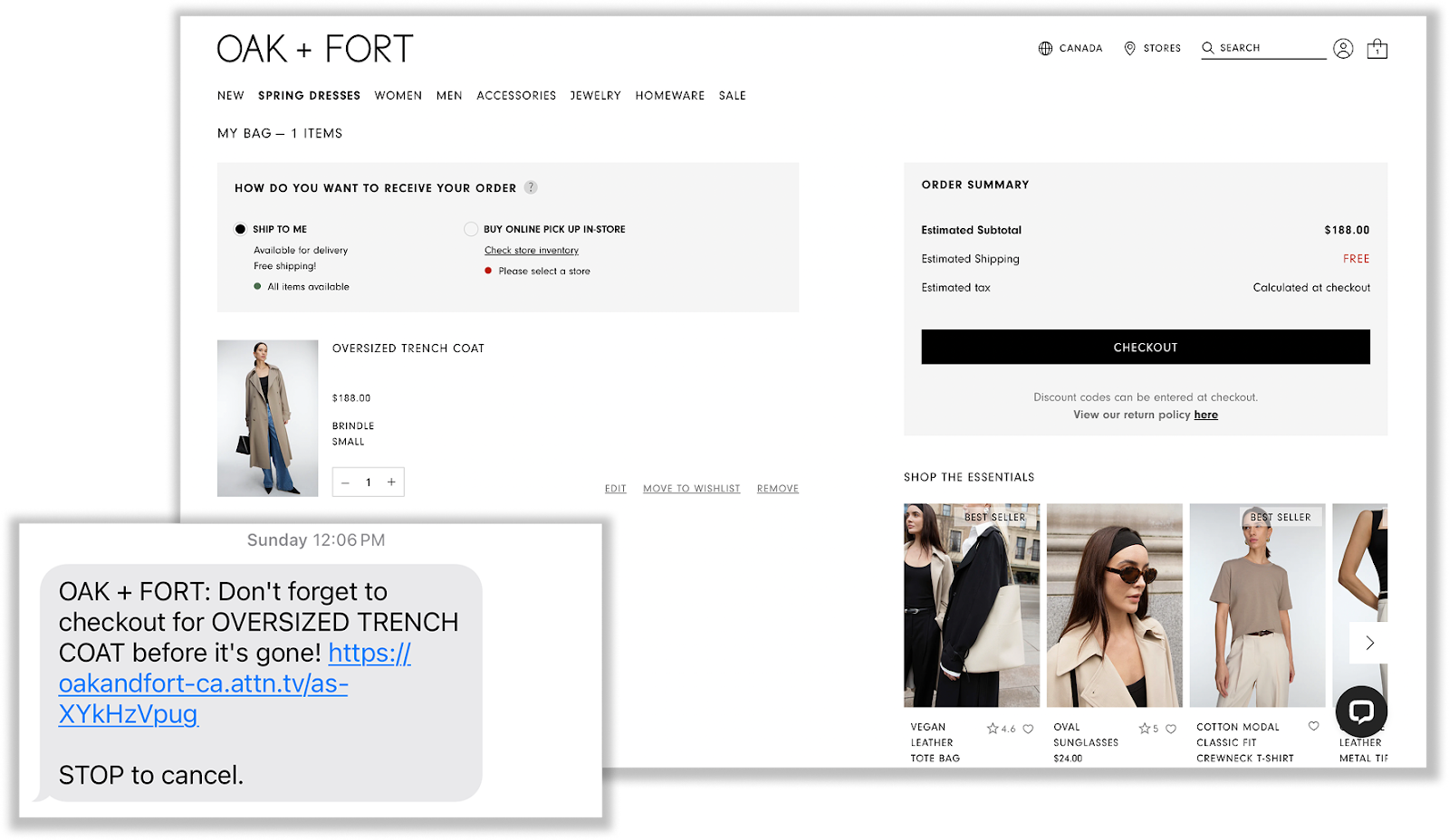
Oak + Fort re-engaged this customer who abandoned their cart through a hyper-personalized SMS. The message:
- Highlighted the specific trench coat they were browsing
- Created urgency by telling them to check out before it sells out
- Provided a link directly to the customer’s cart, making it as seamless as possible to check out
Top takeaway
Cart abandonment campaigns are one of the most effective types of remarketing ads – and for good reason. 45% of cart abandonment emails are opened!
10. Riversol – reduce browse abandonment with personalized outreach
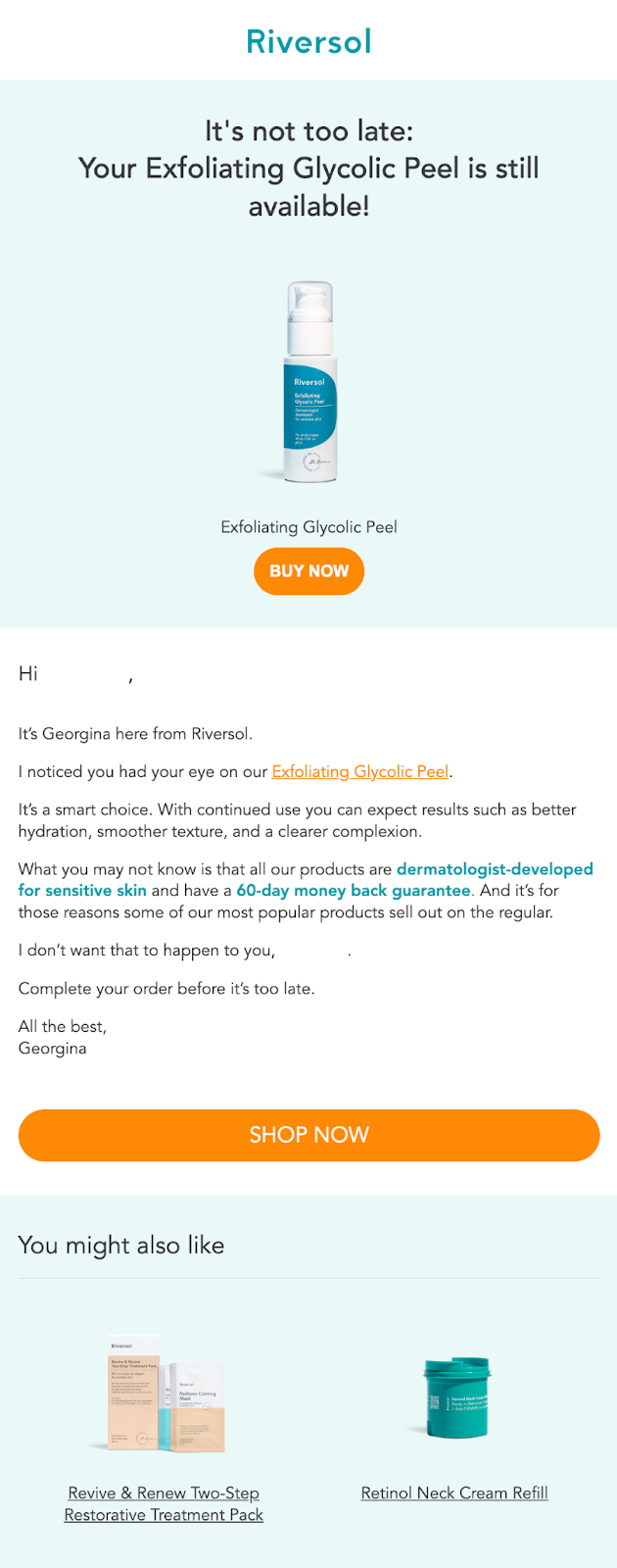
Browse abandonment campaigns are for customers who spent a certain amount of time viewing a certain product without adding it to their cart. Riversol’s remarketing email highlighted the product they were browsing and offered a button to buy now.
It was also followed by a more in-depth explanation of the product benefits and mention of the 60-day money-back guarantee to ease the purchase pressure. They strategically tried to upsell the customer with a “You might also like” section of complementary products too.
Top takeaway
While cart abandonment remarketing often gets the spotlight, don’t forget about browse abandonment campaigns for interested customers who may need a little nudge before they commit.
11. Anna’s Garden – win back dormant customers with a strategic offer
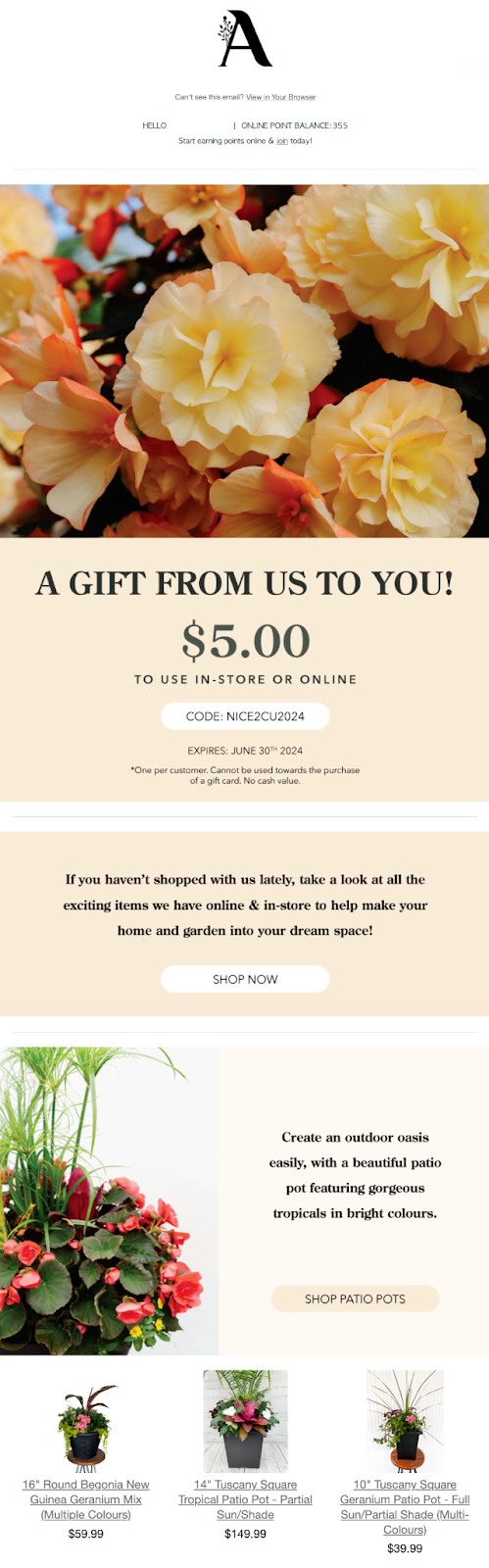
Winback campaigns can help re-engage customers who have shopped with you before but haven’t made a purchase in a while. Anna’s Garden did a beautiful job of this through a remarketing email that offered the customer $5 off their next purchase for a limited amount of time. Then, they followed up with curated product recommendations for the customer.
Top takeaway
Use winback campaigns as an opportunity to remind customers why they shopped with you in the first place.
12. Kiyoko Beauty – spark excitement with restock notifications
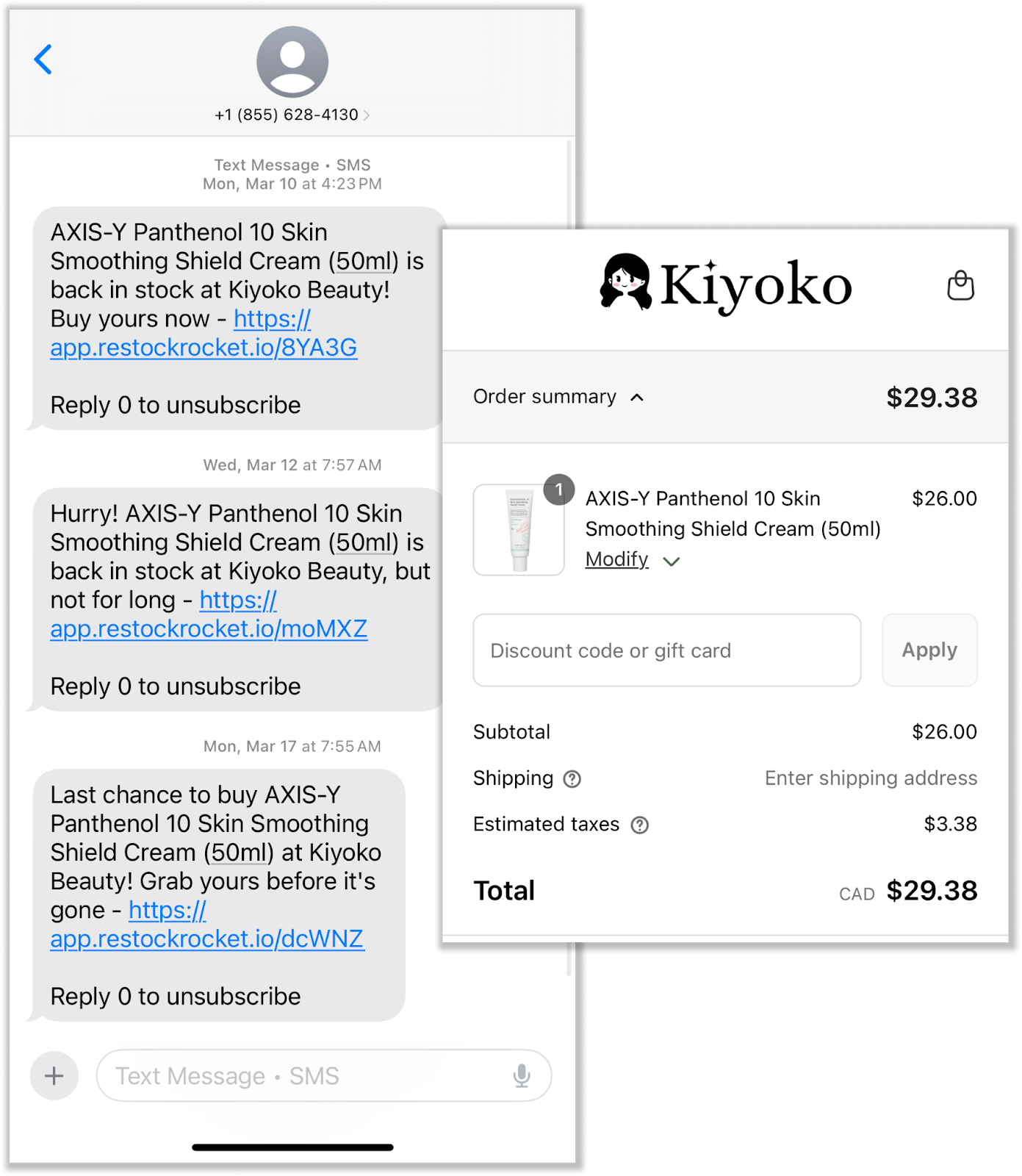
Kiyoko Beauty expertly retargeted a customer through a series of SMS messages telling them that the face cream they were looking at was back.
They use time-based remarketing to send messages every couple of days. Each message created a more urgent call to action by saying “Hurry” and “Last Chance”. When a customer clicked the link, it automatically placed the item in their cart and brought them right to the checkout page.
Top takeaway
If a customer browses a product that’s out of stock, you risk losing them forever – unless you strategically retarget them once that product is back!
13. Paula’s Choice – drive repeat purchases with smart replenishment remarketing campaigns
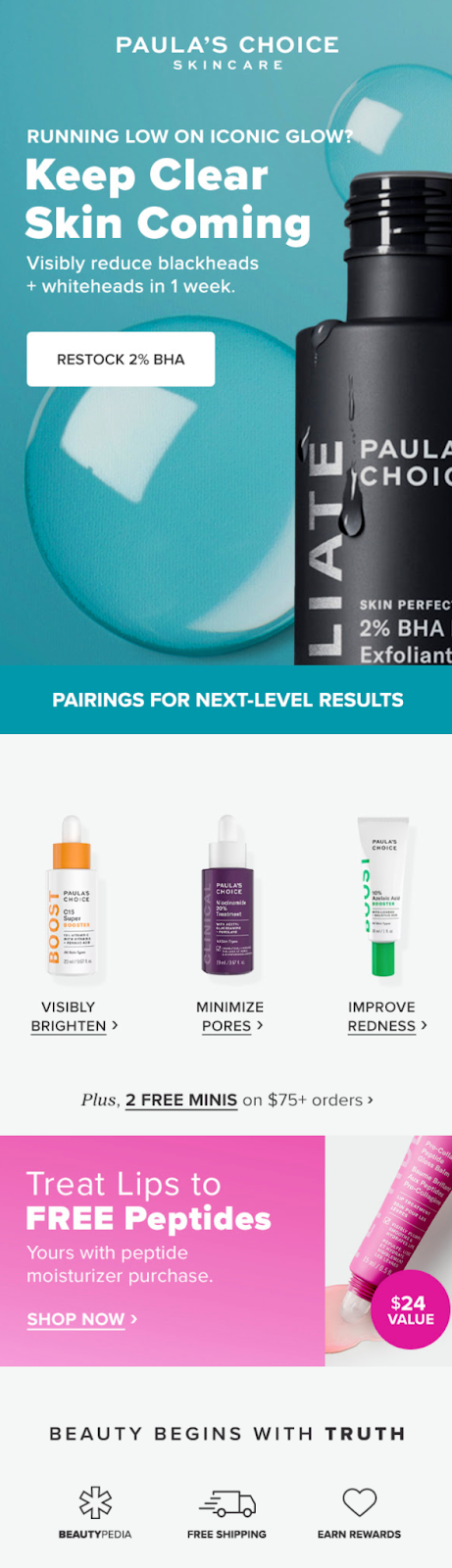
You have tons of customer data at your disposal, so why not use it? Paula’s Choice's sends an email to a customer when it’s time to restock on their exfoliant, as part of a replenishment remarketing campaign. Using customer shopping behaviors lets you send these types of emails at the right point.
Paula’s Choice also uses this as a cross-sell opportunity, recommending complementary products to give the customer “next-level results.”
Top takeaway
First-party customer data, like previous purchases, is one of the best sources to use in remarketing campaigns.
14. Summer Fridays – personalize your outreach through quiz follow-up campaigns

When customers complete a quiz on your website, you get valuable zero-party data that you can use to retarget them. Summer Fridays capitalized on this through personalized remarketing emails sharing a skincare ritual tailored to the customer. That way, they could target the customer’s unique skin type and concerns while showing off their best products to help.
Top takeaway
Not to sound like a broken record, but remember: personalization (like a quiz) is key for your remarketing ad strategy!
15. Crocs – make customers feel special with a gift on their birthday
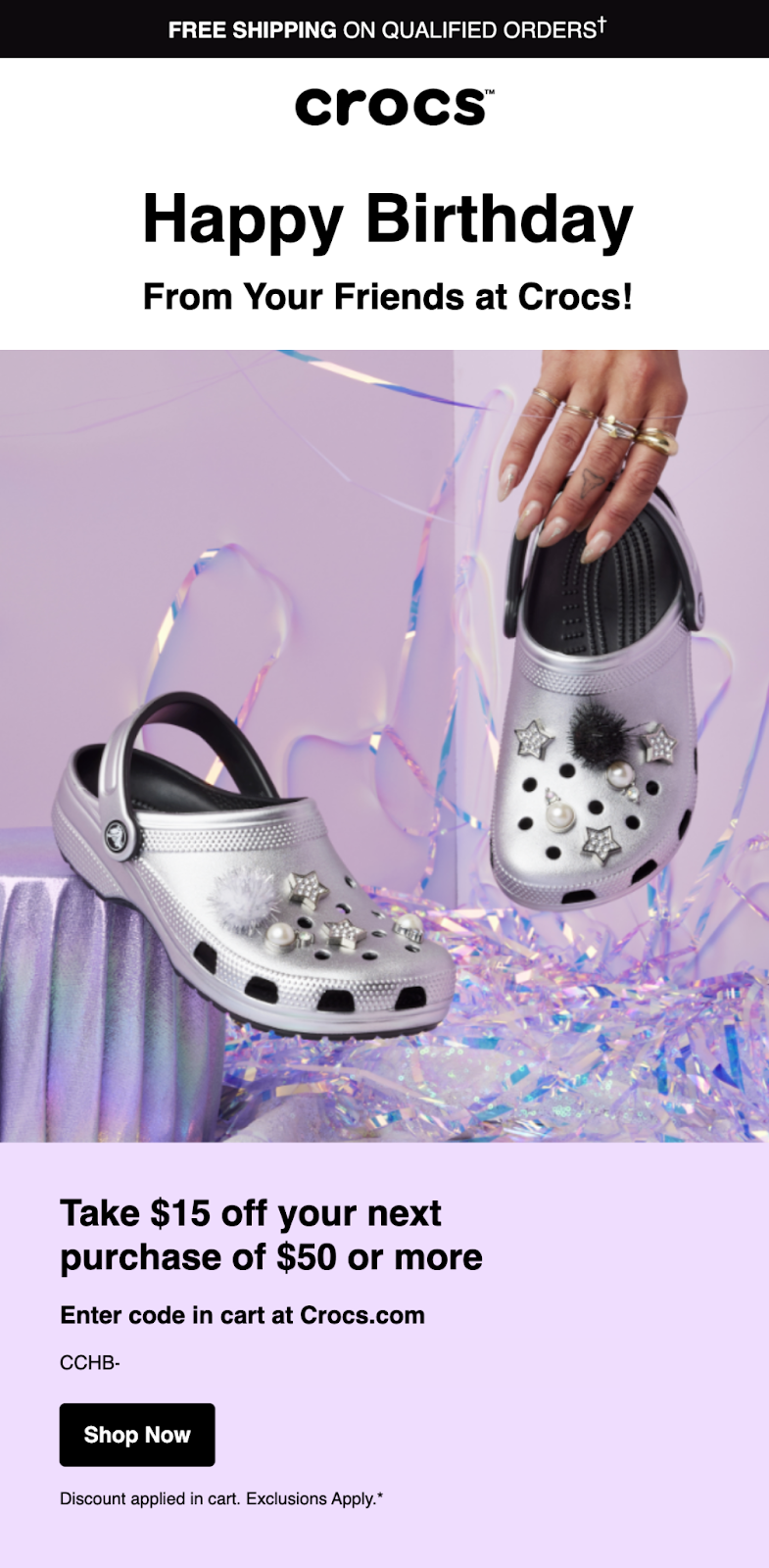
When customers make accounts or loyalty profiles, you collect valuable information about them – like their birthday! Use this information to remarket to them on their special day.
Crocs does a great job at this through a personalized birthday email that offers $15 off the customer’s next order over $50.
Top takeaway
Everyone loves feeling special on their birthday. Take advantage of the customer information you have on-hand for your remarketing strategy.
Retarget customers with Reactiv Clips
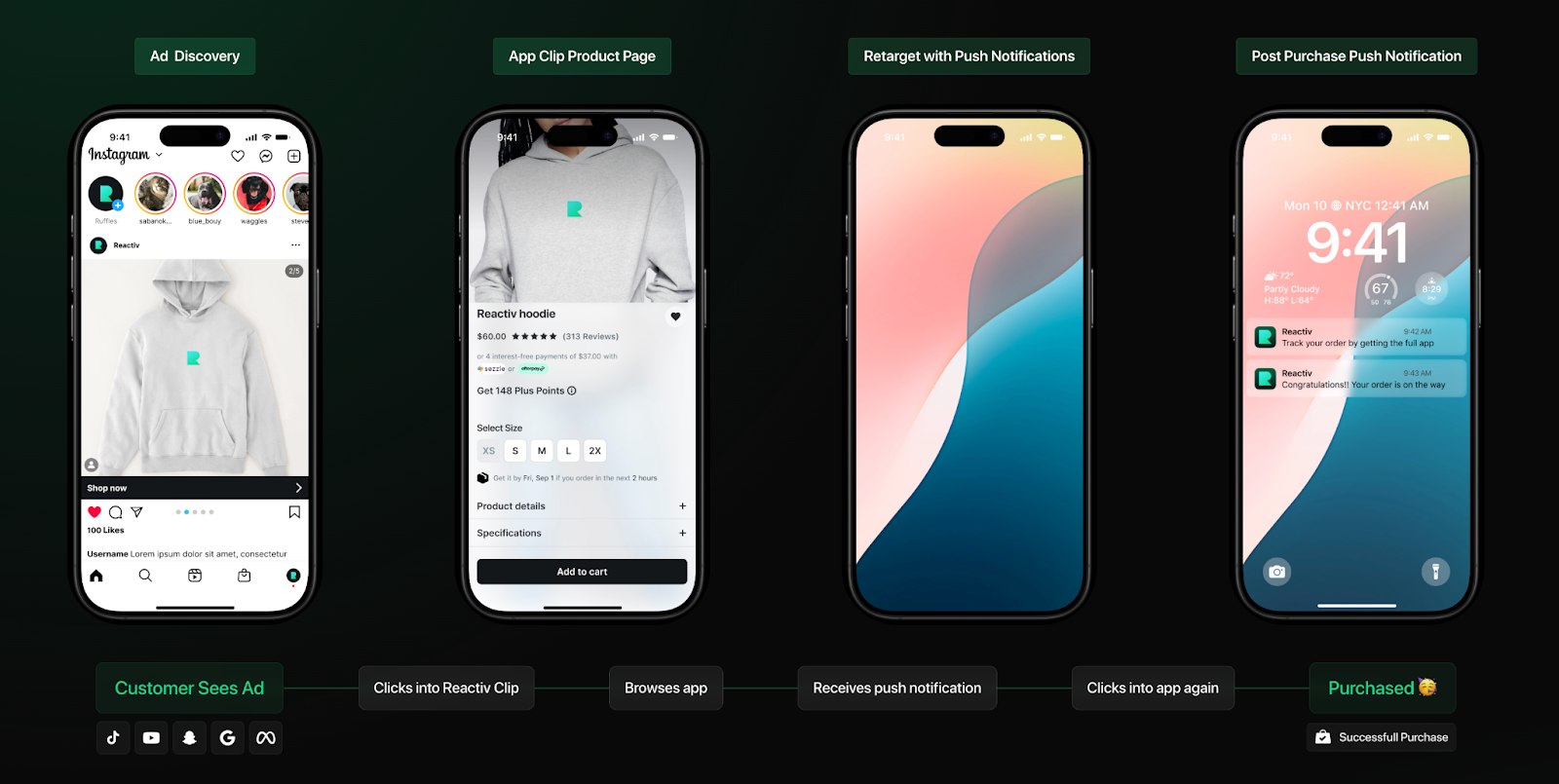
If you’re ready to take your remarketing strategy to the next level, a Reactiv Clip is a lightweight version of a mobile app that allows users to access a specific part of the app's functionality without having to download the full app. Brands can send push notifications to users up to eight hours after they engage with the mobile app page without requiring a download or an opt-in.
That means every single ad click can trigger a personalized follow-up on iOS, helping you reduce customer acquisition cost (CAC) and get more from your ad spend.
Use this strategy to achieve any of the goals of the remarketing ad examples we’ve shared, like:
- Converting a cart abandoner
- Driving sales during time-sensitive promotions
- Creating excitement for new product drops
Take inspiration from the remarketing examples above, have fun with your brand, try a Reactiv Clip and get ready to watch your conversion soar to the stratosphere.
Other Similar Blogs
.png)
Attention to Revenue: 5 Ways to Increase Your ROAS
Let’s be honest, watching revenue roll in feels good.
You launch a campaign, sales start coming through, and the dashboard looks… decent. But then comes the question, “Could this be working harder?”
Because more revenue doesn’t automatically mean better performance.
In ecommerce, attention is rented. Every impression, click, and visit costs something. And if that attention doesn’t convert efficiently, you’re not just leaving money on the table, you’re paying for missed opportunities.
That’s where Return on Ad Spend (ROAS) comes in.
ROAS 101: What is it and how to measure it
ROAS is more than a performance metric, it’s key to understand how efficiently your advertising turns attention into revenue. But increasing ROAS is more than lowering costs, it’s about optimizing the entire customer journey, from first impression to repeat purchase.
It measures the amount of revenue per dollar spent on advertising, key to understanding the efficacy of your digital advertising efforts.
So you launch a campaign and later, the numbers roll in: $10,000 in revenue from $2,500 in Meta ad spend. On paper, it looks like a win….but how much of a win.
The formula is straightforward: ROAS = Revenue from Ads ÷ Ad Spend
In this case, $10,000 divided by $2,500 gives you a 4:1 ROAS. For every dollar spent, four are returned. But the story doesn’t end there.
ROAS measures advertising efficiency, but doesn’t give you the full picture of total business health. A 4:1 ROAS may look impressive, but if 60% of revenue disappears into the cost of goods sold, shipping, and fulfillment, margins shrink quickly and that win starts looking a bit sad.
ROAS vs. Profit
ROAS isolates ad performance, while profit accounts for everything, production, logistics, overhead. ROAS measures efficiency, while profit will tell you about sustainability.
ROAS vs. ROI
ROI zooms out to evaluate the total cost of an initiative. ROAS zooms in, focusing exclusively on advertising spend effectiveness.
ROAS vs. CPA
CPA narrows even further, calculating the average cost to acquire one customer offering a more holistic view of the overall efficacy of digital advertising.
Breakeven ROAS
Beyond just the ROAS, your breakeven ROAS is just as, if not, more important. This is the minimum return required to cover all costs. Before launching any campaign, brands need to know this benchmark. Without it, even strong-looking performance can quietly erode margins.
What looks like just a simple formula, ROAS in practice becomes an advertising strategy guideline. And it works best when you understand what it reveals, and what it leaves out.
ROAS benchmarks for ecommerce
Okay so "What counts as a “good” ROAS?”
The caveat with this is that there's no universal number to go by and call it a day. A “good” ROAS depends heavily on your industry, your margins, your ad platform, and even your campaign objective.
There is no one-size-fits-all standard to aim for, but there are benchmarks to see how you measure up to brands similar to yours.
In 2026, ecommerce performance paints a wide spectrum:
- Average ecommerce ROAS (industry-wide): 2.87:1
- Median ROAS across brands: 2.04:1
- Shopify’s recommended ROAS for profitable scaling: 4:1
- Top 10% of ecommerce advertisers: 8.4:1
That’s a significant range. A 2.87:1 return might be perfectly sustainable for one brand and completely insufficient for another. It’s not about chasing the highest number but to find your competitive context.
Here’s where analytics platforms like Triple Whale step in. As a leading ecommerce intelligence platform, it breaks down ROAS benchmarks by both industry and ad platform, helping brands move from generic averages to meaningful comparisons.

Source: Triple Whale
How strategic retargeting influences ROAS
One of the most common mistakes ecommerce brands make is surprisingly simple: they launch a campaign, watch the traffic roll in, and then… move on. You can’t just move on, think of a breakup you gotta do a bit of creeping before you move on. See if there's anything left first so in this case any potential customers who showed interest see if there’s potential for rekindling.
You need to keep the lines open, let them know they can always come back.
And that’s the beauty of retargeting.
Retargeting re-engages people who have already visited your website or mobile app, serving paid ads tailored to where they left off in their journey. And the performance difference is significant.
Retargeted ads often deliver 5–10x higher ROAS compared to cold traffic campaigns. On Meta, retargeting campaigns can generate a 65% uplift in ROAS, increasing returns from roughly 2.19:1 to 3.61:1.
IF you like numbers then here’s one, users are 70% more likely to convert, because the messaging aligns with their demonstrated intent.
Retargeting recaptures momentum. Because in digital advertising, the first click rarely tells the whole story but the second one often closes it.
5 ways to improve your ecommerce ROAS
“How do you push it higher sustainably?”
1. Use first-party data to sharpen targeting and recover lost revenue
Targeting isn’t what it used to be. Privacy updates have made ads more expensive and less accurate. At the same time, nearly 70% of filled carts are abandoned, contributing to an estimated $18 billion in lost sales annually.
So basically you’re paying more to acquire customers while revenue quietly slips away, doesn’t really sound like a good deal at all.
Zero and first-party data fixes both problems at once: you leverage the data customers willingly give you, sharpening your targeting while re-engaging shoppers who were already close to converting.
What to do:
1. Build first-party audience lists from your email subscribers, prior purchasers, and high-value segments to platforms like Meta and Google as custom audiences.
Shopify Audiences has helped ecommerce brands reduce customer acquisition costs by up to 50% Some have even doubled their retargeting conversion rates compared to traditional interest-based targeting.
2. Use those audiences as seed data for lookalike campaigns. Because they’re built from real buyers, they typically perform far better than broad interest targeting.
But acquisition is only half the opportunity. Cart abandoners represent high-intent shoppers who simply didn’t finish the transaction.
3. Run a multi-channel recovery flow. Brands that connect email, SMS, and push often recover around 12% of abandoned carts.
Without jumping straight to offering a discount.
4. Test urgency or FOMO-driven messaging first. “Only 2 left” or “Selling fast,” preserves margin while still driving conversion and even increasing your ROAS.
Consider the example of bone broth brand Beck’s Broth. The brand retargets both cart and browse abandoners with segmented Meta ads. A shopper who previously viewed its protein hot chocolate might later see a tailored Instagram ad reinforcing that product. When they click, they’re prompted with a 15% welcome offer in exchange for an email subscription.
This strategy brings back the sale, grows the email list, and makes future targeting even stronger.


2. Optimize your ad campaigns; from creative to targeting to bidding
This is where most ecommerce brands pour their energy, and it does matter.
But optimization only works if it’s intentional.
Too often, brands make sudden changes, chase short-term fluctuations, and call it strategy. Constantly tweaking things based on short-term results isn’t a strategy. But testing with intention is. . and here is where it starts:
Ad Creative
Creative is often the biggest performance driver. A stronger hook or sharper visual can double results without changing audience or spend.
Run simple A/B tests over short windows (around two weeks) and change one variable at a time. Test one headline against another and experiment with different CTAs. Explore carousels, short-form video, and dynamic products to see how they perform at various funnel stages.
Targeting: Relevance Over Reach
Broad targeting can feel scalable, but it often waters down performance.
Instead, test high-intent behavioral segments like cart abandoners, product page viewers, repeat visitors. These people have already shown interest. When the message matches that intent, conversions follow.
Read more about retargeting here.
Bidding
Most platforms allow you to set target ROAS goals.
Set your initial target at or slightly below your current average ROAS. This gives the algorithm room to learn while maintaining realistic efficiency expectations. Once results level out, you can slowly raise the target.
When it comes to ad strategy, consider skincare brand Blume. The brand promotes the same 30% discount on its Clear Skin Kit across multiple Instagram ads. The offer stays the same but the framing changes.
One ad leans into social proof and encourages users to “Learn more.” Another invites customers to “Try something new.” The same product and discount, just positioned differently.

That’s strategic optimization: refining how the message lands.
3. Fix the post-click experience
Most brands obsess over the ad…But then they send high-intent traffic to a landing page that only kills the momentum.
This is where the biggest ROAS leaks happen.
Mobile devices now account for 83% of ecommerce traffic, but yet mobile landing pages convert 8% worse than desktop. That gap? That’s friction.
Mobile users behave differently. Meaning now more than ever, specific mobile app conversion strategies are key.
Okay so how are we doing this:
Match Ad to the Message
Nothing makes someone bounce faster than a disconnect between the ad and the landing page.
If your ad promotes a specific pair of shoes, the click should lead directly to that product page, not your homepage or general collections page.
Every extra step gives them a reason to hesitate, and hesitation kills conversions.
Ruthlessly Cut Friction
Make mobile checkout as effortless as possible. Use pre-filled forms, offer a single-page checkout, enable mobile wallet payments like Apple Pay or Google Pay, allow guest checkout, and remove unnecessary fields.
Because 65% of shoppers abandon at checkout, and nearly half of those exits (48%) happen due to unexpected costs.
By the time someone reaches checkout, you’ve already paid to acquire them. At that point, it’s not just a UX issue. It’s a ROAS problem.
Design Mobile-First, Not Mobile-Adjusted
If most of your traffic is mobile (and it likely is), your landing page shouldn’t be a shrunken desktop experience. It should be designed for thumbs.
Make your CTAs easy to find, ideally where the thumbs naturally pause while scrolling, keeping layouts clean.
Consider how Gap approaches this. The brand runs carousel ads on Meta featuring products based on a shopper’s previous browsing behavior, purchase history, or cart activity. When a user clicks a specific item, they land directly on that exact product page.


When there’s no searching or guesswork, the experience feels effortless and without burden. When you’ve already earned the click, your job should be to make conversion the easiest possible next step.
4. Increase AOV and think in terms of LTV over one-time purchases
There are only two ways to improve ROAS: spend less or earn more. Most brands obsess over the first. The smart ones work on the second.Increasing average order value (AOV) and customer lifetime value (LTV) allows you to grow revenue without increasing ad spend.
But also, it gives you strategic flexibility. If you know a customer will stick around, you can afford to ease up on first-purchase ROAS, because the real return comes later.
How to increase ROAS through higher AOV:
Start with free shipping thresholds.
Set them 15–20% above your current AOV so adding one more product feels like the obvious move. Next, surface product bundles directly on your landing pages.
Show “Frequently Bought Together” suggestions or curated best-seller kits that, when done well, naturally encourage larger cart sizes.
And don’t stop once they hit “Place Order.”
Post-purchase upsells
Use your confirmation page and follow up emails to offer one more relevant add-on. No extra ad spend required.
But how does increasing LTV raise ROAS?
LTV changes the entire equation
Repeat customers spend 67% more than new customers. That means the value of acquisition compounds, and isn’t confined to a single purchase.
Start treating your best customers like your best customers.
Your top customers often drive a disproportionate share of revenue. Allocating a budget toward re-engaging them can generate stronger returns than constantly chasing new audiences.
Build loyalty touchpoints into your campaigns.
Use tactics like replenishment reminders, win-back campaigns, and new release campaigns to convert at higher rates and at lower cost. In turn, for higher ROAS.
Don’t overlook app adoption.
Brands with mobile apps see up to 50% higher repeat purchases compared to those without. Running campaigns that drive app downloads can indirectly strengthen retention and in turn long-term ROAS.
Consider AG1’s approach to increasing AOV. The brand promotes a free starter kit valued at $72 to encourage first-time purchases. The catch is to unlock the offer, customers must spend $79 on a 30-serving supply of its flagship product.
This tactic boosts the first order and quietly builds the habit that drives the next one.


5. Retarget mobile users through app-like experiences with Reactiv Clips
Most ROAS advice starts at your website. But what about everyone who never makes it there?
For instance:
- Someone watches your video ad, but doesn’t click.
- Someone clicks, but bounces from a slow mobile landing page.
- Someone interacts, but never completes checkout.
Here’s the problem: traditional retargeting only works if someone makes it to your site. If they don’t? They’re gone.
This is where Reactiv Clips close the gap.
Reactiv Clips bypasses the traditional landing page entirely. When someone taps a Reactiv push notification, they open straight into an app-like experience, no download, no App Store, no friction.
Here is how the flow changes:
- Initial Ad Engagement. A user interacts, but doesn’t convert or fully land on your site.
- Push Notification. The user receives a follow-up notification tailored to the ad they engaged with.
- Native App-Like Experience. The user enters an immersive, app-style interface with product pages, checkout flow, and purchase functionality.
- Purchase. The transaction happens directly within the Clip.
This model closes three performance gaps at once. It brings back users that your pixels never capture, it avoids the slow, leaky mobile pages that kill momentum, and it delivers an experience that feels like an app without having to download anything. Often the issue isn’t the ad itself but what's waiting on the other side of the click. Feel like something’s off with your running ads? Let's talk about it.
If you want to better understand how Reactiv Clips can work for you, listen to learn more.
Raise your ROAS with Reactiv
At every stage of the funnel, friction quietly erodes performance.
Reactiv Clips are designed to close those gaps.
Instead of sending shoppers through the usual mobile maze, Clips turn engagement into a conversion-ready experience instantly. Users open into a fast, app-like flow with no download required. That means you can reconnect with the people most brands lose: video viewers who didn’t click, visitors who bounced, and shoppers who engaged but never finished.
Because Clips reconnect with shoppers while their interest is still warm, push notifications see strong open and engagement rates even beyond typical opt-in windows.
Brands using Clips have reported higher conversion rates, recovered abandoned carts, and boosted AOV, driving up to a 20% lift in ROAS. And Reactiv can help show you how to calculate the profits.
If you want to improve ROAS without increasing ad spend, the opportunity might not always be at the top of the funnel. Sometimes it’s in fixing what happens after engagement, creating a higher-converting mobile path to purchase.
See how it works: Reactiv Clips demo
.png)
Post-click is the trick: Optimizing ad campaigns for better results
You know the moment. You thought your favourite hero was down and out, but suddenly they take up their father’s sword or find a magic stone —or they pull a sword from a stone—and unlock their full potential to win the day.
We may not live in a land of magic and monsters, but in the mobile ad space, there’s a power-up that’s even better: using Reactiv to help optimize your mobile ads.
Reactiv Clips take users straight to product-level content matched to the creative, with fast load times and no required app installs. And you don’t even need to journey to a galaxy far, far away to use it (seriously, you can start today).
But why is mobile ad optimization so important, anyway?
Think of this: even when ads drive clicks, the post-click experience often determines whether a user converts or bounces. In 2024, mobile ad spend also surpassed $400B+, with 82% of all digital ads viewed on mobile devices.
Reactiv optimizes post-click experiences to make every click count. Read on for 5 top tips to help optimize mobile ad campaigns and drive real customer engagement.
What is ad campaign optimization?
Optimizing ad campaigns means improving your ad performance over time to help reach your goals. Think Rocky Balboa running up and down the steps of the Philly Museum of Art. You should put your marketing campaigns to work for you just as hard.
Your exact goals will depend on your campaign purpose, but they might include:
- Higher mobile conversion rates
- Higher app install rates
- Lower cost per acquisition (CPA)
- Higher lifetime value
- Shorter path to purchase
- Anything else you’re optimizing for
But unless your goal is brand awareness, clicks don't automatically equal success. Everyone’s been guilty of accidentally clicking on an ad before bouncing out.
Part of mobile ad optimization means targeting users who intend to buy. This helps lower your return on ad spend (ROAS) and maximize every dollar in your ad budget.
Another tip: what happens after someone clicks on your ad is just as important as the ad itself.
The post-click mobile experience is where the user either converts or bounces. That’s why optimizing every step of your mobile ad funnel—from audience targeting to landing page experience—is key.
Why mobile ad optimization matters more than ever
It’s simple: mobile channels absolutely dominate the early stages of the ecommerce purchase journey.
A whopping 78% of global traffic to retail sites comes from mobile devices. Ecommerce discovery, browsing and even purchases now happen primarily on phones and tablets.
So in a world where shoppers see between 4,000 to 10,000 ads daily, ads optimization is not just important—it’s essential.
Social media platforms like TikTok, Instagram, Facebook, and YouTube. Or Google ads (and other search engines), mail apps, and SMS are also making it harder to unlock your phone screen without seeing an ad. Ad fatigue is a real issue.
The question is, how do you resonate through the noise? How will your ad be the one that a customer will actually remember and act on?
The answer: by optimizing every stage of your ad funnel.
Clicks vs. conversions
It’s key to remember that increased traffic does not equal increased sales. In today’s ecommerce landscape, cart abandonment rates are high.
Around 70% of online shopping carts are abandoned. A further 40% of mobile users abandon pages that take longer than 3 seconds to load.
Most underperforming ad campaigns fail after the click, not before it. So let’s talk more about how to avoid that.
How mobile ad optimization actually works
In a nutshell, mobile ad campaign optimization has four connected layers:
- Traffic source (Meta, Google, TikTok): Determines who sees your ads and how much intent they have before clicking. Based on platform algorithms, formats, objectives and placement context.
- Mobile intent targeting: Filters traffic to users most likely to convert. Uses behavioral signals (product views, past purchases, cart activity) over broad demographics.
- Mobile engagement: Measures whether users actually interact with your mobile experience after the click. Influenced by load speed, relevance and how closely the landing experience matches the ad promise.
- Mobile conversion and re-engagement: Converts engaged users into buyers and recaptures high-intent drop-offs. Uses retargeting, push notifications or follow-up flows that increase lifetime value.
Interested in advertising on Meta? Read our guide to mastering Meta ads.
5 ad optimization strategies for your unique goals
Every stage of a campaign matters—from setting the right goals to perfecting the post-click experience.
So now that you have the basics down, let's dive into actual, tangible strategies to help maximize your mobile ad conversion.
Align campaign goals and KPIs with business outcomes
The first step of any digital marketing or ad campaign is figuring out your goals. What are you working toward? What do you want a potential customer to do once they see your ad?
Mobile ad campaigns ask you to configure these goals directly in the platform and optimize delivery around them.
Once you choose your goals, you also need to align them with an overarching business purpose.
For example, increased ad clicks could support brand awareness where conversions increase revenue. Your next step is to select key performance indicators (KPIs) to track over the course of the campaign.
Use the chart below to help map your goals.
Case study: Paula's Choice
Paula’s Choice, a skincare brand, created a Meta campaign optimizing for conversions of its best-selling exfoliant. See how they’re nudging casual browsers to become buyers by:
- Showcasing social proof like “130,000 5-star reviews”
- Including a “Shop now” button
- Leading customers directly to the product landing page


Use highly personalized audience targeting
As the villain Syndrome famously said in The Incredibles: “When everyone’s super, then no one will be.”
The guy was admittedly a little nuts, but he did have a point. The right audience matters, and targeting everyone in your ad campaign means you’ll likely influence no one.
Customers see-through catch-all ad campaigns. We likely filter through them every day without even realizing it. And it’s not enough to group people together by broad demographics like age or gender, either.
Personalizing your mobile ad campaigns using behaviour signals, customer-journey stage or intent can improve the effectiveness of your ads.
In fact, 70% of retailers that invested in personalizing saw at least a 400% return on investment (ROI) increase.
High-intent segments to target for conversion campaigns
- Product viewers: retarget them with campaigns about the specific product they viewed.
- Cart abandoners: offer customers a time-sensitive discount for a product they left in their cart to drive urgency.
- Past purchasers: show customers something they’ve bought in the past to remind them about it and stay top of mind.
- High-LTV customers: surface subscription-focused ads or product bundles to get more out of your best customers.
Best practices
- Separate prospecting and retargeting campaigns. Customers who are in the discovery or consideration phase have very different intent versus those who are ready to buy.
- Build lookalike audience segments from purchasers, not site traffic. Export segments of your most loyal customers and feed them into digital advertising platforms to target similar shoppers.
- Focus your budget on target audiences most likely to buy. Optimizing your ads leads to lower customer acquisition costs (CAC) and a 10x higher return on ad spend (ROAS).
Case study: Speedo
Speedo (yes, that Speedo!) retargeted this user through a shoppable Instagram carousel ad based on their previous browsing habits. They did this in two simple steps:
- Lead with the actual product the user has browsed before (the goggles)
- Show complementary products like a swim cap and bathing suit to increase potential AOV
Targeting based on purchase intent means the user is more likely to click on the ad or scroll through the carousel.


Consider the creative, format, placement and channel context
Different mobile ad formats generate different levels of attention and intent. Optimizing creatives without considering where and how users see them can get clicks but few conversions.
It’s best to diversify the types of ads you use, where you place them (based on your audience’s behavior) and what they look like. Here are some best practices.
Creative
- Hook viewers in 2–3 seconds by highlighting product value
- Limit text and visual clutter to hold attention
- Let users see the product in action without relying on lifestyle imagery
Format
- Use vertical, full-screen formats
- Video is king on mobile—68% of users engage with mobile video ads
- Avoid copying and pasting desktop-first creatives resized for mobile
- Match format to funnel stage—like detailed explainer ads for discovery and user-generated content (UGC) ads for consideration
Placement
- Use a mix of these different ad types per campaign:
- Feed and Stories ads on social platforms
- Short-form vertical videos like Reels, TikToks, or Shorts
- Shoppable photo or carousel ads
- Display and interstitial ads
- Example: combine short-form video and static photo ads for the same product
Channel context
- Social feeds favor native-looking content
- Video placements reward fast hooks
- Retargeting requires product-level relevance
Case study: Blume
Blume uses different formats, offers and creative messaging throughout its mobile ad campaigns. For in-store displays, they use geo-targeted ads for in-store displays. For the online shopping experience, they use video ads. Finally, they use static images to show product bundles paired with shoppable product bundle cards.
By testing different types of ads across both Facebook and Instagram, Blume sees what converts best and doubles down.


Track and test campaign performance
Much like Batman brooding lovingly over Gotham City, mobile ad campaigns need the same amount of care and attention.
Once your campaigns are live, you need continuous tracking and methodical testing to drive real results in real-time. Without tracking the right performance metrics, traffic may increase but revenue can fall behind.
Testing your ads allows algorithms to fully optimize, reduces money wasted on underperforming ads, and gives you campaign data insights to scale what ads are working.
Successful A/B testing can also bring a 50% increase in AOV per visitor.
What to track
- Focus on conversion-driven KPIs rather than vanity metrics
- Track cost per purchase, mobile conversion rate, ROAS and lifetime value by acquisition channel
- Example: a skincare brand running a conversion-focused ad should track how many users add products to their cart and buy, not clicks or impressions
Common A/B or multivariate testing criteria
- Visual creatives: product images, lifestyle shots, videos, carousel vs. single image
- Messaging: headlines, CTAs, ad copy length and tone
- Ad formats: vertical video, static image, carousel, interstitials, UGC
- Post-click experience: landing page layout, copy, form fields, app install flows
Remember: testing is great, but avoid changing campaign budgets or objectives too often since this resets algorithm learning.
Don’t forget the post-click mobile experience
You’ve worked hard to stand out in the sea of mobile ads. You’ve earned a coveted click. Now, what you do with it can make or break your campaign.
This is where most ad campaigns lose money. Even the best ads fail if the mobile experience after the click is slow, generic or mismatched to user intent.
Remember: 83% of all landing page visits now happen on mobile devices, but only 50% of pages are optimized for mobile. Given this, it’s not surprising that mobile landing pages convert 8% lower than desktop.
Every unoptimized experience is potential revenue lost.
Ad platforms increasingly reward post-click success. Ads that lead to conversions are served more often, while those with high bounce rates see inflated CPAs.
Key areas to increase click-to-conversion success
- Fast load times: Compress images, streamline scripts and avoid heavy mobile frameworks.
- Message match: Ensure the landing page mirrors the ad’s product, offer and creative style to reduce friction. Don’t drop users on your homepage and make them do the heavy lifting to find what’s relevant.
- Clear path to conversion: Minimize taps—users should reach add-to-cart or checkout in as few steps as possible.
- Mobile-specific optimization: Use responsive layouts, full-screen product images and tap-friendly buttons.
- Social proof and product relevance: Highlight reviews, ratings or dynamic products.
Case study: Indigo
Indigo nailed the post-click experience in this Facebook campaign for their 2026 reading challenge. Here’s what they did:
- The user sees an aesthetic bingo-style graphic encouraging them to “Read more. Scroll less” with a matching caption
- They click and land on a page that explains the challenge, adds value and aligns visually with fonts, colours, and logos
- They download the challenge and get their own Bingo card to save on their phone
This works great because it’s meant to add value at every stage. Indigo promised users a reading challenge—and that’s exactly what they get. There’s no secret ploy to sell books or products that disrupts the flow.


Ready to power your clicks to conversions with Reactiv?
Optimizing ad campaigns doesn’t end with targeting, creative, or budget. It continues after the click. And that requires a whole lifecycle and marketing strategy on its own.
For mobile-first ecommerce brands, the post-click experience is one of the biggest opportunities for improving ROAS and lowering CPA. That’s where Reactiv fits in.
Reactiv acts as a post-click optimization layer, removing friction and making every click count. With Reactiv Clips, users land instantly on product-level content tailored to the creative without slow load times or forced app installs.
The results? Lower bounce rates, higher conversions and ad spend that keeps working beyond the click.
Reactiv closes the gap between engagement and conversion, optimizing campaigns both the ad funnel and the mobile experience.
.png)
8 customer acquisition strategies to promote your Shopify store
Shopify is a lot like chess.
Sounds weird, right? But hear us out – both are easy to learn, hard to master, and involve a lot of moving pieces. And when it comes to strategy – the kind that makes you a chess or Shopify grandmaster – standing out from the crowd takes time, patience, and practice.
And it’s a big crowd: there are currently 2,744,406 active Shopify stores. That’s a lot. This gigantic number is why average online conversion rates are sitting around 2%.
To add salt to the ecommerce wound, acquisition is also only getting more expensive. Between Apple’s iOS privacy updates, the phaseout of third-party cookies, and tightening data laws, it’s becoming harder for brands to retarget customers through paid ads and pixel tracking.
So how do you promote your Shopify store effectively? The answer is a healthy mix of customer acquisition methods, and we’re breaking down 8 of them in this article.
Let’s dive in!
What is customer acquisition?
Let’s start with the basics: customer acquisition is the process of attracting and converting new shoppers into paying customers through a mix of organic, paid, and owned.
The key success metric to monitor is Customer Acquisition Cost (CAC) – the average amount spent to acquire a new customer. This average CAC for stores is rising year-over-year – the current average in 2025 is $70-$80 (up 40% from 2023).
Customer acquisition isn’t a one-and-done – it’s an ongoing process for you and a multi-touch, omnichannel journey for your customers. A shopper might see an Instagram ad, read a blog post, scan a QR code, and get a push notification – all before finally converting.
With this mini lesson out of the way, let’s take a look at how to advertise a Shopify store through 8 powerful customer acquisition methods.
#1 - Paid ads and retargeting
Remember how we said it’s becoming harder to attract and re-convert customers through paid ads and retargeting? It is, but that doesn’t mean you should ignore it.
Despite the limitations, paid ads are still a key part of acquiring new customers.
One big change is the way you use this strategy: with the aforementioned privacy restrictions in place, successful ad campaigns now depend on owned data and hyper-personalized messaging. Instead of casting a wide net, focus on granular targeting to reach specific segments.
Paid ads platforms to try
- Meta (Facebook/Instagram): great for social proof or product carousel ads
- Google Search & Shopping: powerful when targeting high-intent buyers ready to make a purchase
- TikTok: an impactful platform for discovery-driven audiences
Using retargeting
Setting up the campaign is only half of the strategy – retargeting is the yin to paid ads’ yang. Retargeting allows you to cash in on your messaging and convert customers who didn’t make a purchase the first time around. While 70.22% of online carts are abandoned, effective retargeting can help you recover around 26% of them.
Paid ads and retargeting in action
Good Protein is a good user of paid ads and retargeting. By pairing social ad retargeting with a welcome offer to encourage first-time purchases, they have a customer acquisition plan that comes together as deliciously as a mixture of their chocolate and peanut butter-flavoured shakes.

#2 - Reactiv Clips
Getting a prospective customer to download your app is a tough sell. It’s time-consuming, takes up precious storage on their device, and, honestly, it’s just kind of a whole thing. That’s why Reactiv Clips are such a powerful mobile engagement tool.
What’s a Reactiv Clip?
Reactiv Clips are lightweight versions of mobile apps. They allow users to access specific parts and features of your app without actually having to download it.
With an open rate of over 60%, Reactiv Clips are the perfect way to let potential customers experience your app without the risk of them bouncing before downloading. Plus, once someone engages, you have an 8-hour window to send personalized push notifications – no opt-in needed.
A typical Reactiv Clip user flow
Here’s a look at how a hypothetical customer (we’ll call him “Bill”) would interact with your brand using Reactiv Clips:
- Bill clicks your Instagram ad, leading him to a Reactiv Clip. Hi Bill!
- This immediately launches your product or collection landing page.
- Bill leaves the page to respond to his multitude of Instagram DMs.
- Bill is retargeted with a personalized push notification. He clicks the notification, bringing him directly to the checkout page with the product already in his cart.
- Bill places the order.
- He receives a push notification encouraging him to download the full app to track his purchase. Great work, Bill!

As you can see from Bill’s ecommerce adventure, Reactiv Clips take a few moves off a customer’s path to checkout, providing a streamlined experience for them and a stronger conversion flow for you. Win/win!
P.S. Social ads are just one of many ways to use Reactiv Clips in your campaign. More use cases can be found here.
#3 - Conversational commerce: Shopping via LLMs
The rise of AI chat tools like ChatGPT, Claude, and Gemini has sparked a new era of shopping called conversational commerce. Instead of scrolling through product pages or sifting through Google results, shoppers are simply asking AI to find what they want.
And it’s taking off fast: the global conversational‑commerce market is projected to grow from roughly US $8.8 billion in 2025 to about US $32.7 billion by 2035 (CAGR ~14.3 %). Ecommerce brands are clearly betting big on AI-powered shopping.
How conversational commerce impacts Shopify stores
Conversational commerce means your Shopify store can now be discovered inside AI chats – where customers are actively making purchase decisions. OpenAI has even made it possible for Shopify brands to let customers check out directly in ChatGPT, effectively consolidating the entire customer journey into one chat.
This trend combines personalization, immediacy and conversion. Shoppers get contextual recommendations, while brands gain a new channel to acquire high-intent customers.
Improving your visibility on LLMs
To appear more frequently on LLMs, optimize your product descriptions, collections and overall content for Answer Engine Optimization (AEO). AEO involves optimizing your content to be better understood, trusted and sourced by LLMs.
Strong AEO helps your store and products appear when shoppers ask intent-driven questions like “I’m gluten intolerant. Help me find a probiotic supplement to improve my gut health”.
AEO in action
Cozy Earth wraps their customers in comfort – and their content in strong AEO. When our hypothetical friend Bill asked ChatGPT for a “cooling sheet set,” it responded with helpful tips and product recommendations – including a set from Cozy Earth.


Retargeting customers via LLMs
With more and more customers getting product recommendations from LLMs, retargeting them just makes sense. Reactiv is the only platform that lets you do this. With Reactiv, you can:
- Run Reactiv Clips directly out of ChatGPT and other LLMs
- Send shoppers to a mobile app (without requiring a download!)
- Retarget them for 8 hours with push notifications
Conversational commerce is redefining the customer journey – make sure your pieces are on the board so you’re part of the game.
#4 - Email marketing
Email marketing predates the modern internet, with the first recorded instance occurring in 1978. There’s a reason it’s still around: it works.
While the first-ever marketing email was sent unsolicited by Gary Thuerk (giving him the nickname “Father of Spam”), today’s email marketing couldn’t be more different.
Powered by owned, zero-party data, customers are now choosing to hear from you by actively showing interest in your brand. This powerful (and profitable - the average ROI per $1 spent is $36 - $40) intent makes them the perfect candidate for future outreach.
Building your email list
If you don’t already have an email list, it’s never too late to start:
- Before opening your store, create a pre-launch page: You’ll have to pair this with another strategy to get the word out, but having a list of interested customers before you start selling gives you zero-party data from day zero.
- Add opt-in forms across your site: Make signing up worthwhile by offering perks like early access to new releases, exclusive discounts or product tutorials.
- Run giveaways: Incentivize sign-ups by offering a simple reward or contest entry. It’s a quick, time-tested way to grow your list.
Remarketing with re-engagement flows
Once a customer creates an account with your store, email becomes a powerful re-engagement tool. Remarket them with re-engagement flows like:
- Welcome sequences for first-time visitors
- Abandoned cart triggers
- Running promotional or holiday-specific campaigns
Email marketing in action
Indigo is one of Canada’s favourite bookstores and one of our favourite users of email retargeting. When customers browse a book but don’t purchase, Indigo sends a “Take a second peek” email that’s supplemented with additional books from the customer’s wishlist. This strategy is personal, timely, and a powerful way to encourage customers to take another look.

With email marketing, it’s all about the setup. Start building your list and strategy early, and you’ll keep reaping the rewards.
#5 - Organic content marketing
While it’s easy to get distracted by flashy new options, organic content remains one of the best strategies to market your Shopify store, especially when you’re just getting started.
Why? It’s free.
Free is good… And practical.
Organic content lets you test your messaging, drive discovery, and build an engaged community before investing in paid ads. Over time, present-day community members can become profitable future customers.
Organic content marketing formats
Organic content comes in many formats – mix and match to see what resonates most with different segments:
- Blog posts
- Product tutorials and guides
- YouTube videos
- Social media content
- FAQs
- And more – you’re only limited by your imagination!
Once you create content in one format, repurpose it across others. For example, a cosmetics brand could turn its YouTube tutorial for its new eyeshadow palette into a TikTok video, an Instagram carousel, a blog post, and an infographic. One great idea, multiple different channels!
SEO and AEO for organic content
Organic content is also a powerful tool for showing up in both search engines and LLMs.
Use search engine optimization (SEO) and AEO best practices across your site – including blogs, product descriptions, and tutorials – to improve visibility and organic discovery.
Let’s say you’re a skincare brand writing a holiday product guide – you’d want to include searchable queries like “best winter skincare routine” (you can find these using SEO keyword research tools). This will help you appear in both Google results and AI-driven discovery experiences.
Content marketing in action
Missouri Star Quilt Company is a star in SEO and AEO content marketing.
Beyond their shop, their site features hundreds of quilting tutorials, blogs, and templates to attract new and experienced crafting enthusiasts – all rich with keywords.
They also worked with Reactiv to prioritize the in-app tutorial experience through searchable content linked to products and patterns. In less than 2 weeks, they were able to attract 50,000 new app users. That’s a lot of stitches and a lot of app users!


Organic content might take longer to see results, but it builds an essential foundation for your brand. Once it clicks, your board will be set for long-term success.
#6 - Geolocation-triggered tactics
For years, ecommerce and retail have been treated like opposing forces. But shoppers never saw a difference. They move seamlessly between stores, mobile, and desktop, expecting every interaction to feel like part of one brand experience.
As of 2025, 73% of retail consumers identify as omnichannel shoppers: browsing online, researching on mobile, and buying in person. Yet most acquisition strategies are still built in silos. It’s time to bridge both worlds.
With Reactiv Clips, brands can bridge that gap effortlessly.
Using geolocation triggers, NFC taps, or QR codes, Shopify brands can create fluid, real-world moments that convert on the spot and feed right back into their digital ecosystem.
Picture this:
- A shopper walking past your store gets a Siri prompt to explore your latest collection.
- Fans at a stadium can buy a jersey instantly from their phone without having to download anything.
- A nearby coffee lover gets a notification to order ahead from your café and skip the line.

Once a shopper interacts with one of these Reactiv Clip experiences, brands can send push notifications and personalized updates that strengthen the relationship long after that first scan or tap.
Here are some creative ways you can leverage this:
1. Turning every store shelf into an interactive experience
QR codes on shelves or product tags can instantly unlock:
- sizing guides
- ingredient details
- UGC
- care instructions
- customer reviews
- stock availability (especially for variants not displayed on the floor)
Customers can pull up this information on their phones instantly.
2. Converting retail visitors into digital subscribers
Clips let shoppers opt into:
- loyalty programs
- product launch notifications
- restock alerts
- limited-time in-store offers
…right from the aisle they’re standing in. (Or seat they’re sitting in, like how we built this experience for a basketball game at Madison Square Garden.)


3. Recovering missed sales in-store
If a location is out of a product or a size, Clips can automatically open a pre-filled cart for:
- ship-to-home
- same-day courier
- pickup at the next-nearest store
It removes the “we’re out” friction and saves an otherwise lost sale.
4. Turning staff into storytellers, not cashiers
Reactiv Clips give store associates tools they can pull up instantly to:
- demo complex products
- share comparison charts
- guide purchases
- trigger add-ons or bundles
- text a Clip to the customer for later
This turns retail into a high-conversion consultative experience.
#7 - Influencer marketing and partnerships
If you’ve been on any form of social media or video platform in the last decade, you’ve encountered influencers.
And for good reason: influencer marketing has become a staple in many acquisition strategies because it gives you access to one of the most effective ways to reach new audiences – leveraging someone else’s.
Finding the right influencer
By working with an influencer, you’re able to tap into the trust and engagement a creator has already built with their audience.
This makes choosing the right influencer incredibly important – you need to ensure you’re reaching your ideal customers and that your message comes across as authentic. As tempting as it may be, partnering with the right micro-influencer is often a lot more powerful than splurging on Kim Kardashian.
Play your cards right, and you can see incredible success: 31% of social media users say they prefer discovering new products through influencers they follow over any other format or channel. For Gen Z, this climbs to 43%!
Influencer strategies to drive acquisition
There are endless ways to work with influencers to drive acquisition, such as:
- Using personalized discount codes or affiliate links to track engagement and measure ROI
- Collaborating on unboxings, tutorials or TikToks that drive directly to your Shopify store
- Use Reactiv Clips to sponsor influencer posts from your store’s social accounts to driving users directly to an app-like experience
Influencer marketing in action
Mejuri may be a fine jewelry brand, but their influencer marketing is more than fine.
Fine jewelry – especially online – is a hyper-competitive market, so Mejuri leverages a wide network of creators and influencers to break through the noise.
Just take a look at their #MejuriPartner hashtag, and you’ll find thousands of posts with hauls, unboxing videos, jewelry tours, and more.


When you find the right creators to partner with, it’s not about spending money on the biggest star you can find – it’s about making the right moves to set you up for success later in the game.
#8 - Loyalty and referral programs
It makes sense that a referral program is a strong acquisition strategy that doesn’t break the bank – but you might be surprised to learn loyalty programs are, too.
In fact, they’re more than strong: 79% of customers say they’re willing to create a store account in exchange for loyalty points.
Once you have their data, you can add them to segments and re-engage via email, SMS, and other channels to secure that first purchase. Loyalty programs are also an excellent incentive for app downloads – pair them with exclusive app-only offers, bonus points, or personalized content to drive app engagement.
With a referral program, you can leverage the loyal customers you already have to do your marketing for you.
Strategies and tactics for loyalty and referral programs
There are plenty of great Shopify app options to build your loyalty and referral programs in minutes, including:
Once you have your foundation in place, use these tactics to get started:
- Add referral code prompting post-purchase emails and order confirmation pages.
- Incentivize social shares and repeat purchases with loyalty points.
- Understand and track key referral metrics such as the number of referrers, referred new customers, cost per referral, and the retention rate of referred shoppers.
Loyalty and referral programs in action
Obvi obvi-ously knows what they’re doing when it comes to loyalty and referral programs. Not only do they offer a robust rewards program with multiple ways to earn points, but their referral program also benefits both sides: referrers and new customers each receive a $15 discount on their next purchase. That’s one healthy discount!
Sticking with our chess analogy, every customer is another piece on the board – the right loyalty and referral programs let you set them up to play the long game.
Promote your Shopify stores wherever your customers are
People aren’t monolithic. There’s no magic “one size fits all” approach to customer acquisition, even with the most niche target audience.
With omnichannel shopping more common than ever and customers receiving messages on every possible platform, it’s important to capture customers across multiple touchpoints with a strong multichannel strategy. The best way to tie it all together? Reactiv Clips.
Pairing Reactiv with these customer acquisition strategy examples, like influencer campaigns, paid ads, email, SMS, and geolocation-triggered tactics, will ensure you stay top of mind and can re-engage customers wherever they are.
Interested? Talk to our team today and start turning your acquisition strategy into a winning board.
Built to adapt at every stage
We’re here to power your mobile success now and in the future
See Reactiv in Action