
What it really costs to bring a customer back: app vs website
Every return visit to your website costs you: email, SMS, retargeting. Here's how an installed app changes the cost of a repeat purchase.
October 26, 2026
5 min read
In this article

Subscribe to Our Newsletter
Get mobile commerce insights. No fluff, just what you need to build smarter.
"People can just shop on my website."
I hear it from founders who might be on the fence about an app. And they're right. They can. Your website works, your checkout works, and nobody needs an app to buy from you.
But there's a second question that rarely gets asked: what gets them back there?
Unless you're Amazon, nobody types your URL from memory on a Tuesday afternoon. Pull up last month's returning customers and look at what brought each one back. For most brands, almost every repeat visit started with something you paid for.
This post is about the customers you already have and the full app on their phone. Winning a first order works differently, and that's where App Clips come in; I'll touch on them briefly. The focus here is what it costs to bring people back.
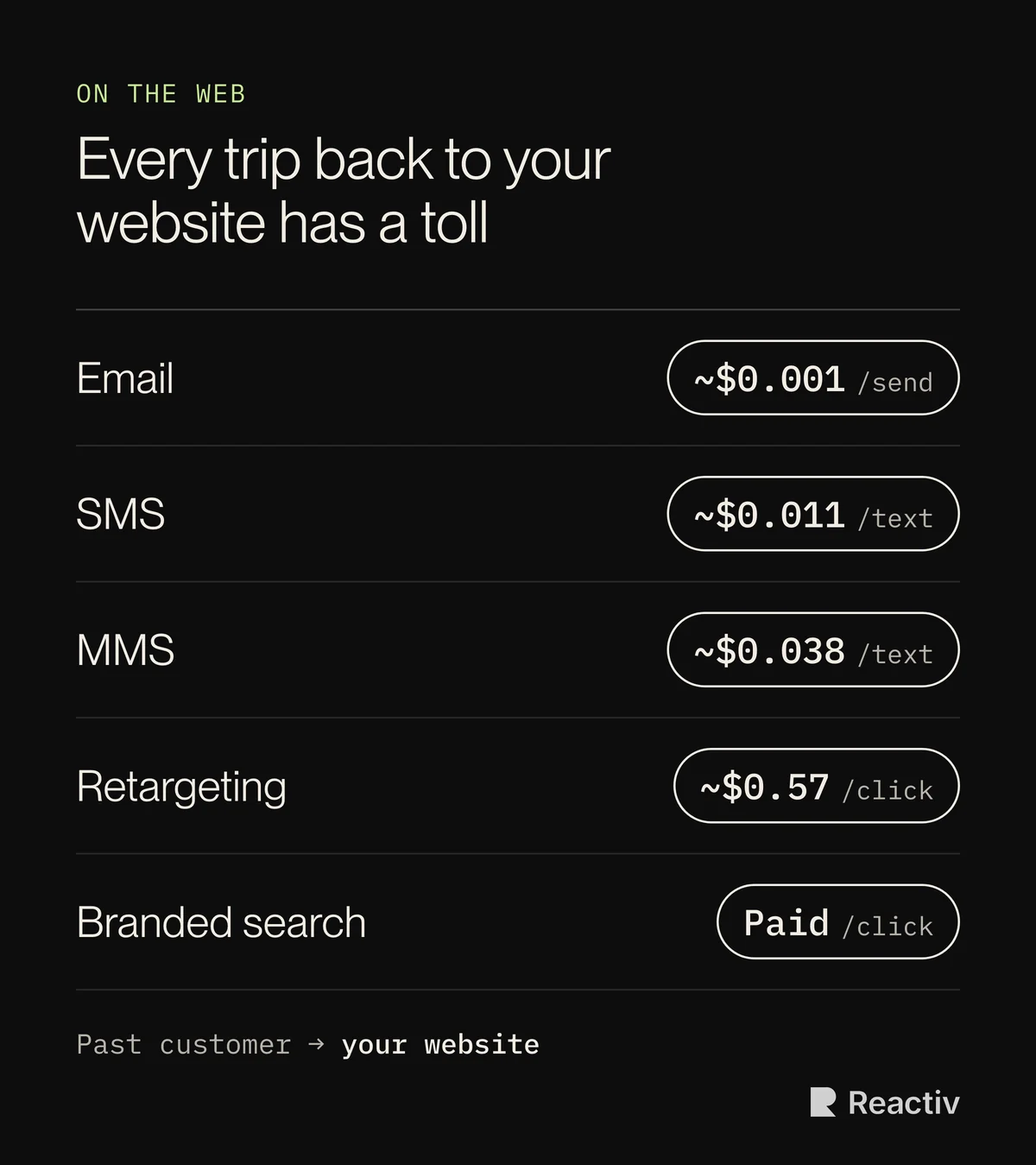
Every trip back to your website has a toll
There are four ways a past customer gets back to your site, and each one costs you something.
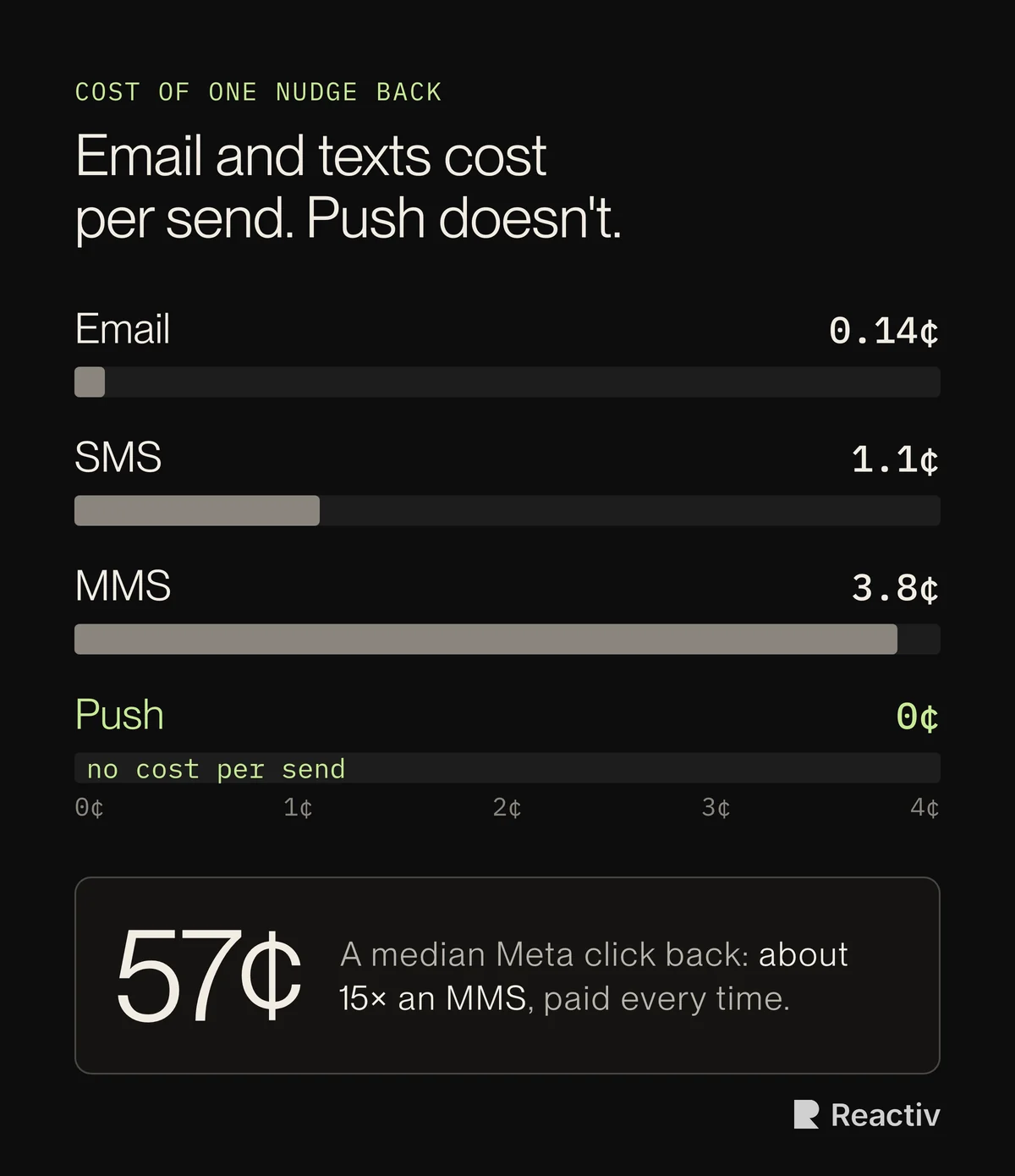
Email. Cheap per send, about a tenth of a cent, but you pay for the whole list every month, whether people open or not. A 100,000-profile list on Klaviyo runs about $1,380 a month.1
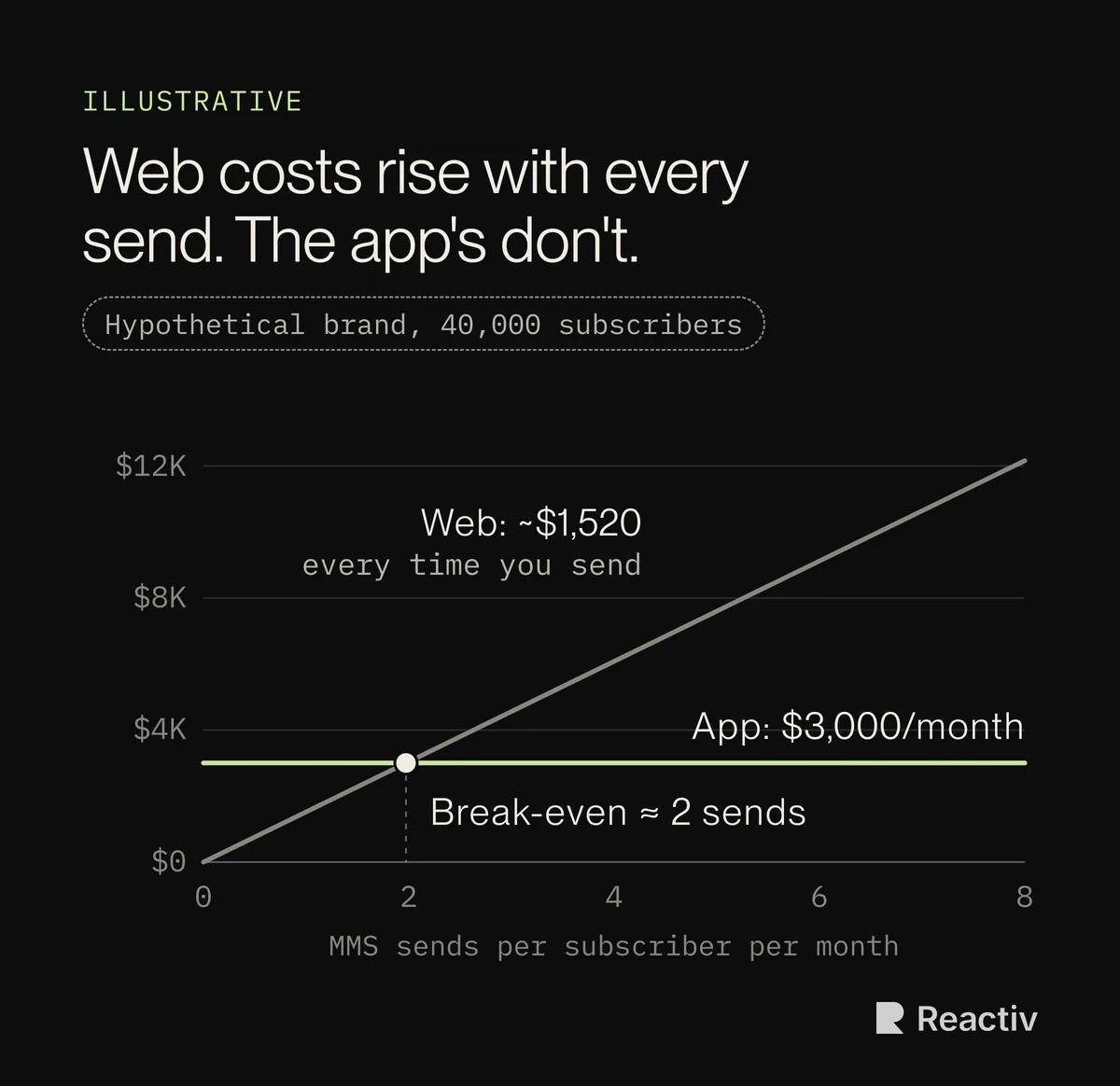
SMS. A text costs about a cent once carrier fees are in, and an MMS with an image about 4 cents.2 Send 40,000 subscribers eight MMS campaigns a month and that's about $12,000 a month.3
Paid retargeting. You already paid to acquire this customer once; now you pay again. A median Meta click for DTC brands costs about 57 cents.4
Branded search. Many returning customers Google your name, and many brands pay to win that click before a competitor does.
Some customers come back on their own, but you can't trigger that when a restock lands or a sale starts.
On the web, purchase frequency is metered. Want customers back twice a month instead of once? Send twice as many texts. The cost of bringing someone back scales with how often you want them back.
An app removes the toll
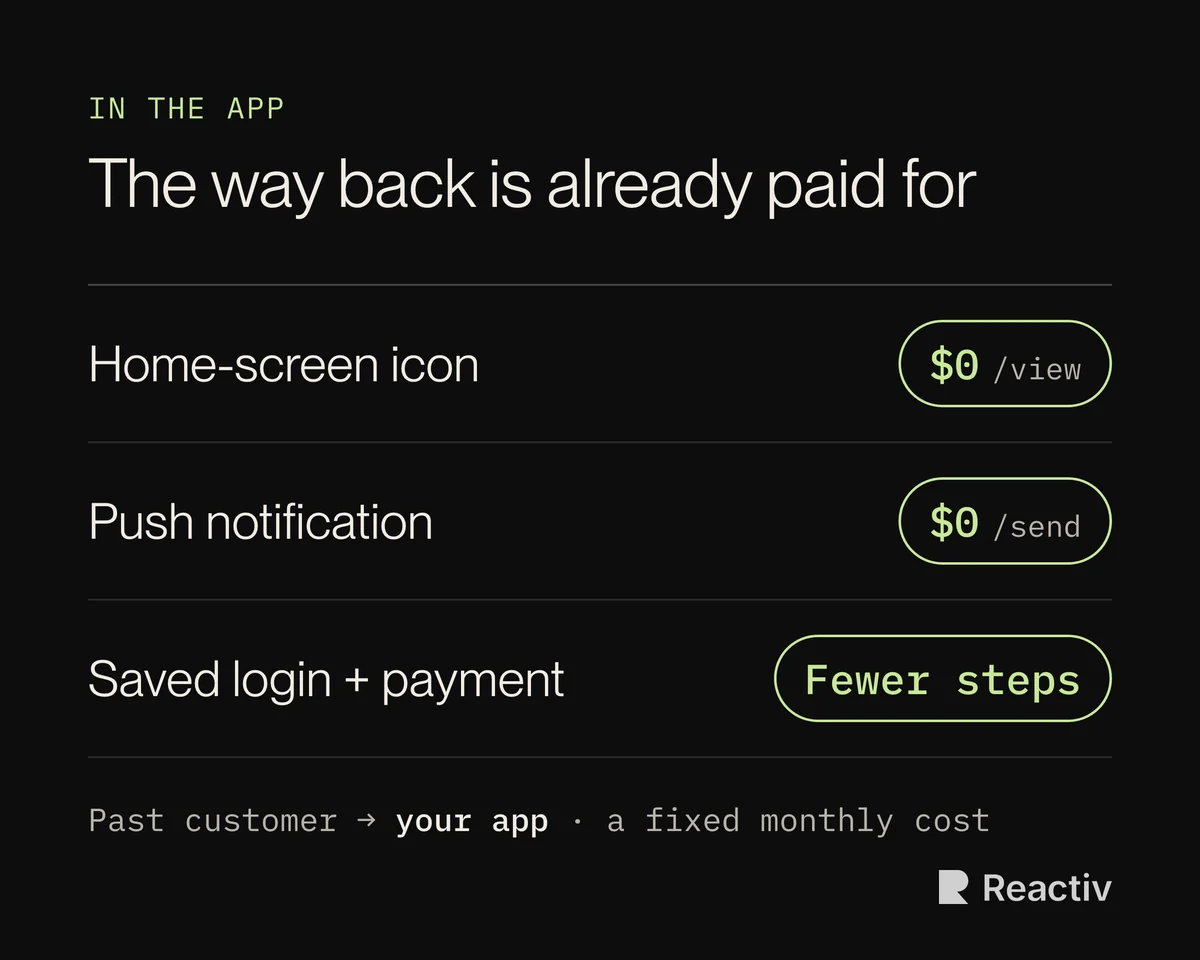
An app changes the cost structure, not just the experience, in three ways.
It lives on the phone. Your icon sits on a screen your customer unlocks dozens of times a day, a reminder you don't pay for.
Push has no cost per send. Once someone opts in, one more notification costs you nothing extra.
Coming back takes less effort. They're already logged in, with payment details saved.
On the web, re-engagement is a variable cost. With an app, most of it becomes a fixed one.
You can see it in how app customers come back. Across Reactiv apps, about two-thirds of purchase sessions start with a push tap or with no marketing link at all. Only about 1 in 20 starts with a paid ad click.5
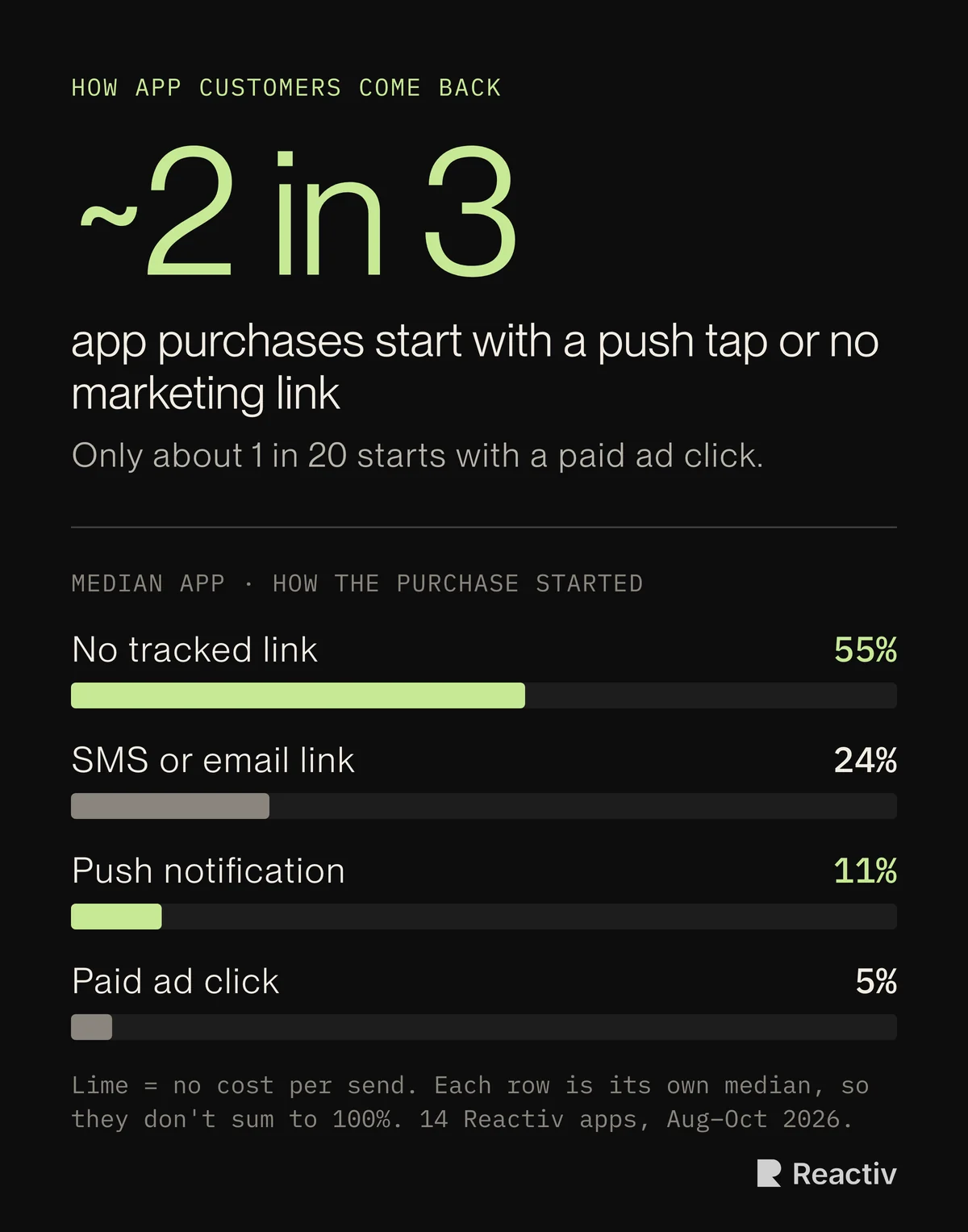
SMS and email still start about a quarter of app purchases, so an app doesn't replace your retention stack. It reduces how often you pay to bring someone back.
Once they're back, they also buy more. In Reactiv customer data, a native app converts at about 2x the rate of mobile web, and an installed app lifts average order value by about 20%.
What an app doesn't do
An app doesn't create demand. Your website and your app are both surfaces: they convert demand that already exists. Ads, creators, press and word of mouth create it.
"App share of revenue" is the wrong scorecard. If a loyal customer moves their orders from your website to your app, you haven't lost anything, and the app hasn't "made" anything either. What matters is whether that customer buys more often in total, and whether bringing them back costs you less.
Watch out for the pull-forward trap. A purchase that happens sooner looks like a new one if your measurement window is short. Treat lift measured over less than about 90 days as possibly just timing.
So what does an app actually produce? Two things, and a bit of a third:

In short: more return visits, each one cheaper to drive.
There's one place the economics extend to acquisition: App Clips. A Clip is a lightweight, native version of your app that opens straight from an ad, with no download. It doesn't create demand either, but it converts more of the paid traffic you already buy: in Reactiv customer data, App Clips convert ad traffic at up to 3x the rate of mobile web. That's margin again, this time on the cost to acquire. (Clips run on iPhone; Android shoppers land on your mobile site.)
Clips also feed the retention story: an average of 15% of Clip visitors install the full app, turning traffic you paid for once into customers you can bring back without paying per send. More on Clips in what an App Clip is; this post is about what happens after the first order.
The math that actually matters
That turns the ROI question into arithmetic. An app is a fixed monthly cost, so you can work out what it needs to do to pay for itself:
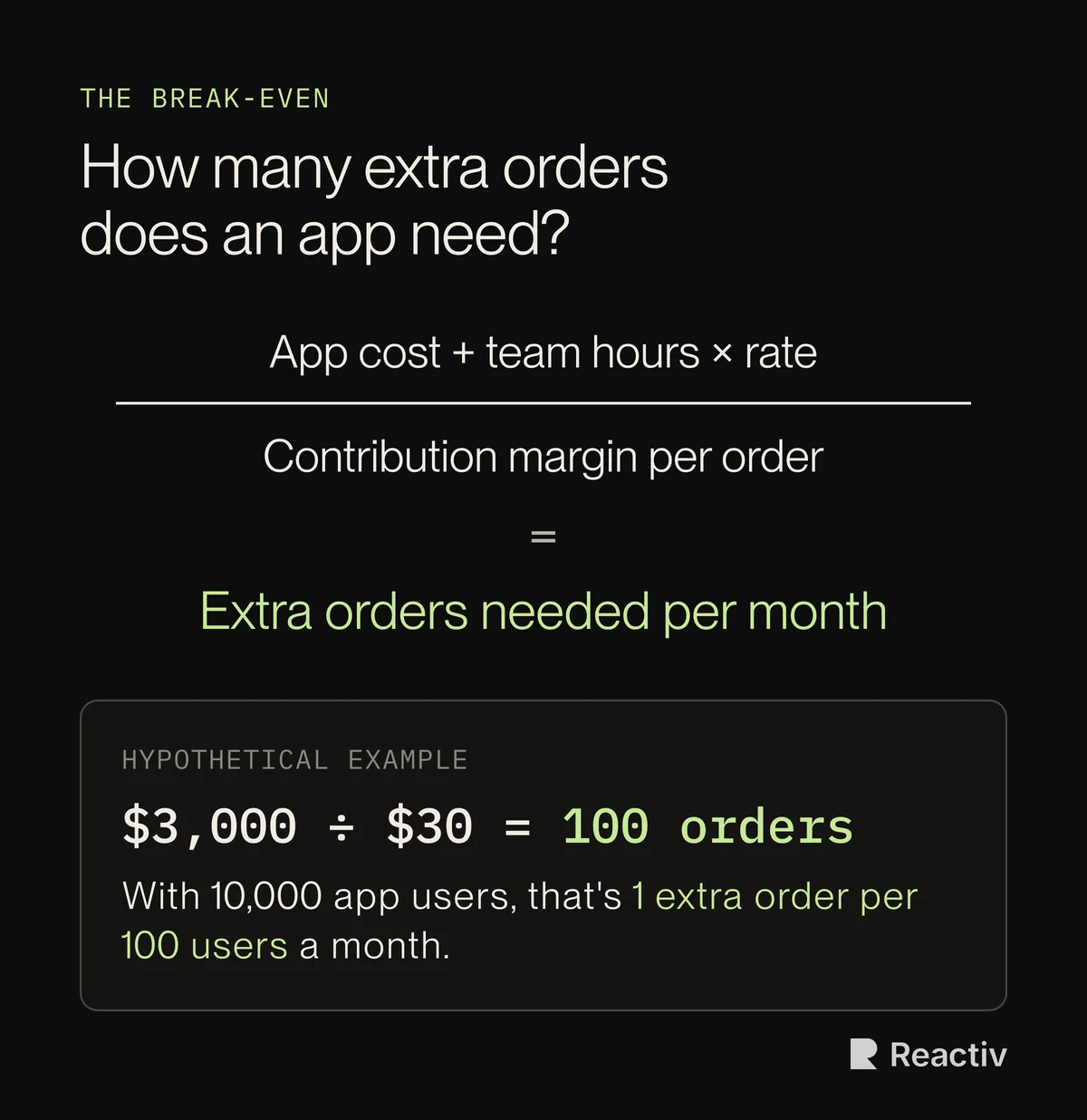
Here's a hypothetical. Say your app costs $3,000 a month all in (platform plus your team's time) and your contribution margin is $30 per order. You need 100 extra orders a month to break even.
With 10,000 people using the app, that's one extra order per 100 app users per month. It's a low bar.
Then add the savings. If a brand with 40,000 SMS subscribers moved two of its eight monthly MMS campaigns to push, it would save roughly $3,000 a month in sending costs.6 In this example, that alone covers the app.
Your numbers will be different, and the inputs are all in your own reporting.
How to test it on your own data
You don't need to take our word for it. Two tests do most of the work:
Push holdout. Hold push back from a random slice of your app users for 90 days or more, then compare total spend across both groups, on every channel.
Intent-to-treat. Hold back the "download our app" prompt from a random part of your customer list, then compare total spend between the two groups, whether or not anyone installed. This shows the app's effect on your whole business, not just on customers who were always going to install.
For both tests, measure contribution margin across all channels, not revenue the app claims credit for.
Do the math on your brand
Your website will always be a great place to shop. The question is how much you pay every time you need someone to come back to it.
Bring your contribution margin and last month's SMS and email spend. We'll work out your break-even with you, and tell you honestly if the numbers don't work. Book a call.
Related: What push notification data tells us about CRO and The BFCM checklist for brands with a mobile app.
Sources
- Klaviyo email pricing at 95,001–100,000 active profiles, as listed on klaviyo.com/pricing (captured May 2026). Includes 1,000,000 sends a month.
- Postscript Growth plan: $0.008 per SMS and $0.03 per MMS, plus average US carrier fees of $0.0033 per SMS and $0.008 per MMS. postscript.io/pricing, accessed October 2026. Other platforms and plans vary.
- 40,000 subscribers × 8 sends × ~$0.038 per MMS ≈ $12,200 a month. Sent as plain SMS, it's about $3,600.
- Median Meta CPC across 15 DTC brands, July 2025 to June 2026, all Meta traffic (not retargeting only). Top Growth Marketing.
- Reactiv customer data, median of 14 apps with 300 or more purchase sessions, August to October 2026. A session counts as "no marketing link" when it carried no tracked campaign link. This includes customers opening the app from their home screen.
- 40,000 subscribers × 2 sends × ~$0.038 ≈ $3,000 a month. Illustrative only.



See Reactiv on your storefront.
Book a demo and we'll walk you through native apps and App Clips running on your Shopify store.